Understanding Protists: The Diverse Kingdom of Eukaryotic Microorganisms
Protists are a diverse group of eukaryotic organisms observed as microscopic "creatures" in pond water. Classified into three categories based on their nutritional methods—animal-like (heterotrophs), plant-like (autotrophs), and fungus-like (decomposers)—these microorganisms play essential roles in ecosystems. They reproduce mainly through binary fission, and some can exchange genetic material with similar species. This article explores their classifications, characteristics, and the significance of algae, which are foundational to Earth's food chains and oxygen production.

Understanding Protists: The Diverse Kingdom of Eukaryotic Microorganisms
E N D
Presentation Transcript
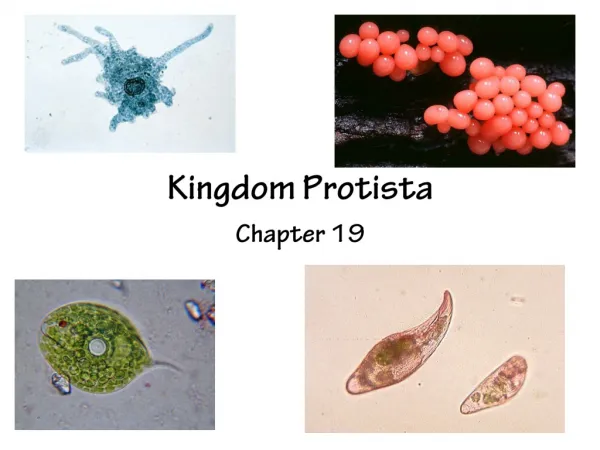
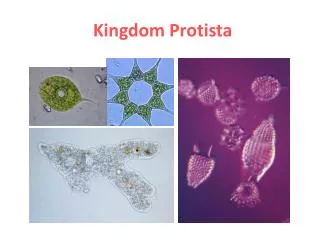
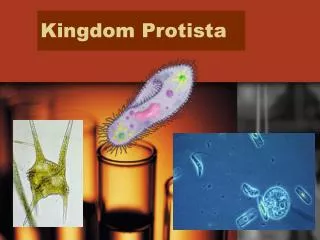
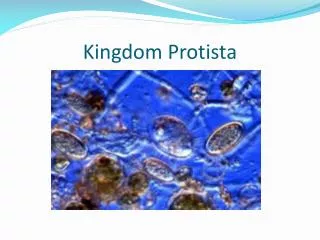
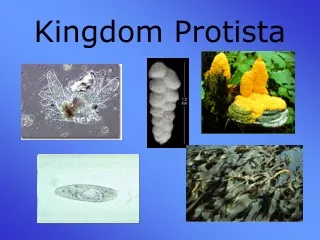
If you look at a drop of pond water under a microscope, all the "little creatures" you see swimming around are protists.
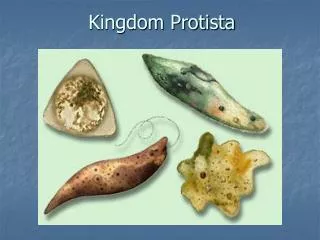
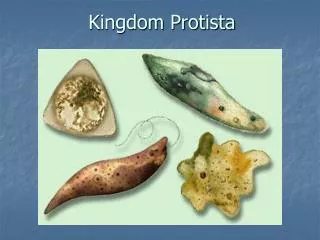
All protists have a nucleus and are therefore eukaryotic. • Protists are eitherplant-like, animal-likeorfungus-like. • Protists reproduce by binary fission and some can transfer genetic material between organisms of the same species only.
Protists are primarily classified according to how they obtain nutrition: • Animal-like—heterotrophs • (eat other organisms) • b. Plant-like—autotrophs • They contain chloroplasts • and make their own food • (photosynthesis). • Fungus-like— • Decomposers/Heterotrophs Didinium eating Paramecium Green like plants! Water mold
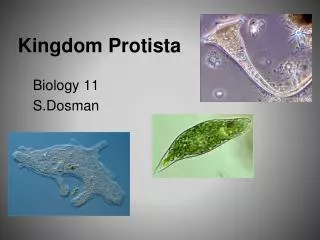
All protozoa digest their food in stomach-like compartments called vacuoles <vac-you-ohls>. As they chow down, they make and give off nitrogen, which is an element that plants and other higher creatures can use. • Protozoa range in size from 1/5,000 to 1/50 of an inch (5 to 500 µm) in diameter. They can be classified into three general groups based on how they move.
Plant-like protists are algae. • Algae are eukaryotic autotrophs. • They, along with other eukaryotic autotrophs, form the foundation of Earth’s food chains. • They produce much of Earth’s oxygen.
There are three unicellular phyla of algae: • Phylum Euglenophyta • Phylum Bacillariophyta • Phylum Dinoflagellata
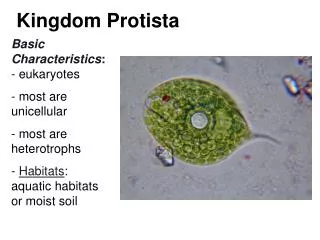
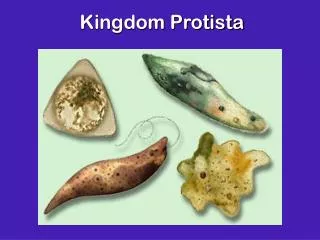
Members of first phylum of algae, Euglenophyta, are bothplant-like and animal-like. • Euglena are autotrophs since they make food from sunlight and • Heterotrophs since they ingest food from surrounding water.
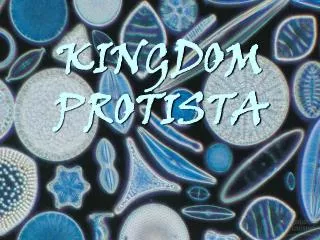
The second unicellular algae,Bacillariophyta, are photosynthetic autotrophs. • They have shells of silica. • They make up a large portion of the world’s phytoplankton which is Earth’s largest provider of oxygen.
The third unicellular algae,dinoflagellatesfrom Dinoflagellata, are a major component of marine phytoplankton. • These algae have at least two flagella set at right angles to each other and thick cell walls made of cellulose plates. • Blooms of dinoflagellates cause “Red Tide.”
Rhodophyta arered seaweeds. • They are found in warm or cold marine environments along coast lines in deeper water. • They absorb green, violet, and blue light waves. These light waves are able to penetrate below 100 meters.
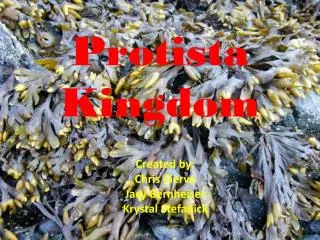
Phylum Phaeophyta is made up of thebrown algae. • They are found in cool saltwater along rocky coasts. • Giant Kelp are the largest and most complex brown algae. They have hold fasts and air bladders.
The last of the multicellular algae are the green algae from thePhylum chlorophyta. • Most green algae are found in fresh water habitats.
A Volvox is a hollow boll composed of hundreds of flagellated cells in a single layer.