Optimizing Fatigue Strength in Brazed Structures with High Density Materials
80 likes | 102 Vues
Learn about maximizing fatigue strength in brazed structures through high density materials such as Cu-OFE, CuZr, and GlidCop. Discover how dislocation density and alloying affect strength. Explore the effects of cold working and aging on materials' properties.


Optimizing Fatigue Strength in Brazed Structures with High Density Materials
E N D
Presentation Transcript
Samuli Heikkinen, CLIC meeting 22.2.2008 - To be confirmed - +
Higher strength is generally achieved by blocking the dislocation motion • Dislocations can block the movement of each others if the dislocation density is high • Cold working increases the dislocation density • Impurities can block the dislocation motion alloying GlidCop Cold worked and material has high dislocation density. GlidCop has “naturally” high density 1*10²² 1/m³ of small 7 nm Al2O3 particles (average spacing 46 nm). Elevated temperatures does not modify the Al2O3 particles. Dislocation density decreases and the material becomes slightly softer. Cu-Zr Cold worked material has high dislocation density and aged material has high density 2.6*10²³ 1/m³ of small 1-4 nm Cu5Zr precipitates (average spacing 16 nm). Elevated temperatures (700°C) “overage” the material decrease Cu5Zr precipitate density to 0.7*10²¹ 1/m³ and increase their size to 40 nm (average spacing 113 nm) softer material. Cu-OFE Cold worked material has high dislocation density. Elevated temperatures (>150°C) decrease the dislocation density and result in a softer material. Grain size has only a secondary effect. For annealed copper smaller grain size can increase the strength by blocking the dislocations moving freely in the grain. For cold worked copper the difference is not significant. σ σ σ Small grain size High grain size Cw + aging cw Cw + aging 0 0 0 Small grain size is typically 50-100 µm. Dislocation density can be for copper 10¹² 1/cm² (spacing 10 nm) Heated layer of CLIC structures is about 20 µm.
Fatigue strengths [MPa] (CLIC lifetime values) RF fatigue Criteria: visually observed damage (RF still happy) Mechanical fatigue Criteria: crack planned CLIC limit 56ºC
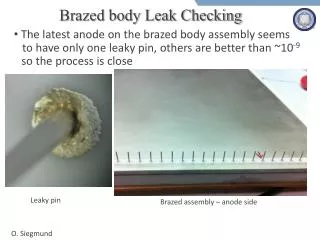
Candidates: Cu-OFE (C10100),CuZr (C15000),GlidCop Al-15 Laser Ultrasound RF RF
Fatigue by RF experiments Cu-OFE_1 (ΔT ~ 70ºC) after N=2*10^6 CuZr_2 (ΔT ~ 70ºC) after N=10^7 Cu-OFE_2 (ΔT ~ 110ºC) after N=2*10^6 Cu-OFE_2 (ΔT ~ 70ºC) after N=10^7 CuZr_1 (ΔT ~ 100ºC) after N=10^7 Fatigued zone “soft” CuZr! No change in RF performance was observed during the runs! RF breakdown zones 110ºC 70ºC 70ºC