

SlideServe
Menu
Préférences
© SlideServe · v2026

William Blake

toki avatar
11 diapositives · 315 Views · Jul 24, 2014

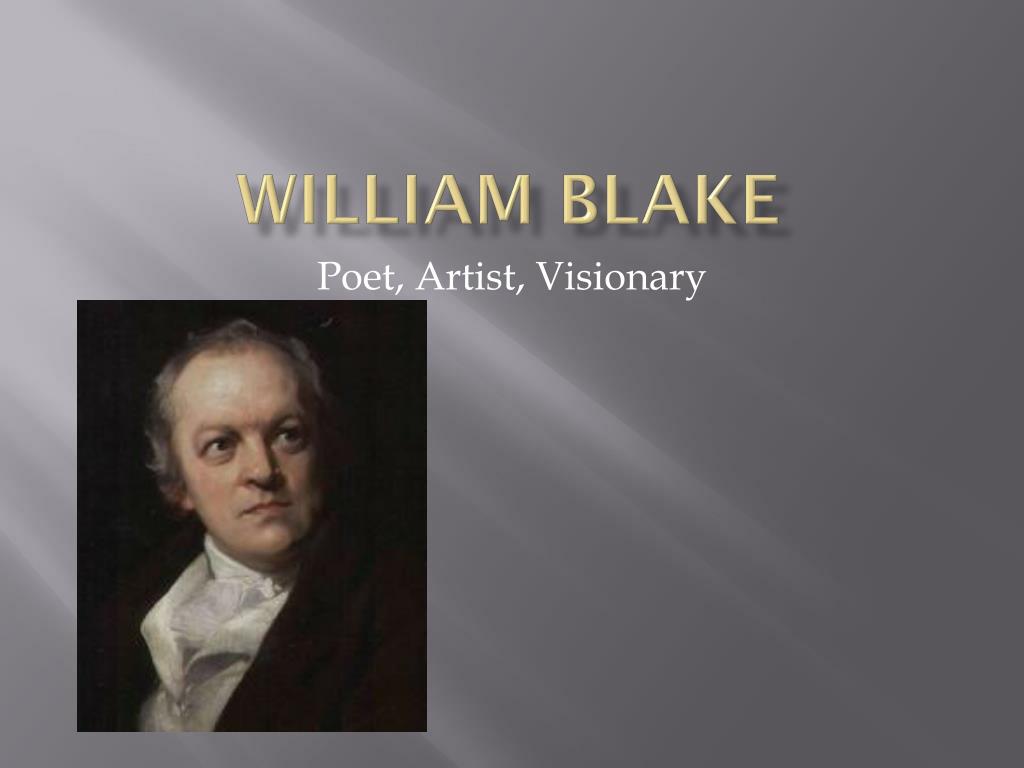
William Blake. Poet, Artist, Visionary. Single-handedly given credit for ending an era and influencing Romanticism Is considered a poet, painter, and engraver (often all 3 were in one book). Philosophy. Our way of life is founded on mistaken beliefs, leading to war and poverty
William Blake - slide 1
01 / 11William Blake
1 / 17

Télécharger la présentation

William Blake
Une image / un lien ci-dessous est fourni (tel quel) pour télécharger la présentation

Politique de téléchargement : le contenu du site vous est fourni TEL QUEL pour votre information et votre usage personnel ; il ne peut être vendu, concédé sous licence ni partagé sur d’autres sites sans l’accord de son auteur.Le contenu vous est fourni TEL QUEL, pour votre information et votre usage personnel uniquement. Téléchargez la présentation en cliquant sur ce lien. Lors du téléchargement, si vous ne parvenez pas à télécharger une présentation, l’éditeur a peut-être supprimé le fichier de son serveur.Pendant le téléchargement, si vous ne parvenez pas à obtenir une présentation, le fichier a peut-être été supprimé par l’éditeur.

F I N

Plus de contenu associé

Transcription de la présentation
  1. William Blake Poet, Artist, Visionary

  2. Single-handedly given credit for ending an era and influencing Romanticism • Is considered a poet, painter, and engraver (often all 3 were in one book)

  3. Philosophy • Our way of life is founded on mistaken beliefs, leading to war and poverty • We only know a small part of our reality through our 5 senses • We must learn to trust our instincts/intuitions, energies, and imaginations **Blake felt that we only concern ourselves with scientific truths and materialistic values**

  4. Poet of Contrary? • Called “mad” = later declared a genius • Worked tediously by hand=industrial revolution • Emotional=age of reason • Simple theme=ornate styles

  5. Major works • Songs of Innocence • Songs of Experience **Companion volumes showing “2 contrary states of human experience.”

  6. Innocence • Joy, spontaneity, and oblivious to evil • May discuss evil but not aware of its existence

  7. Experience • Destruction of the state of innocence because it leads to awareness of evil and ugliness (not all doom and gloom, though) • Blake NEVER meant to suggest that one was better than the other. Rather BOTH are necessary to reach a third, optimal state

  8. Organized Innocence • An existence based on knowledge of contraries and happiness “Without contraries there can be no progression” **Must pass through both innocence and experience to arrive at an existence based on knowledge and happiness.

  9. “Without contraries there can be no progression” What does this mean???