Download
1 / 31
310 likes | 428 Vues
Welcome to Mrs. Harris' Science Class! Find your seat using the student information sheet and start filling it out. Make sure to place your tissues, paper towels, and hand sanitizer in the back. This guide outlines the structure of our Science Journal, including sections for notes, papers, and flashback activities designed to enhance your learning. We will cover the basics of science, the scientific method, and essential tools for measurements. Be prepared for an engaging journey through the wonders of science over the next nine weeks!

E N D
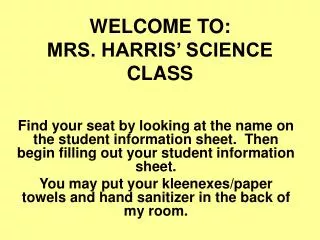
WELCOME TO:MRS. HARRIS’ SCIENCE CLASS Find your seat by looking at the name on the student information sheet. Then begin filling out your student information sheet. You may put your kleenexes/paper towels and hand sanitizer in the back of my room.
Good morningIf you have not filled out your Section 2 Table of Contents, do so now
I. Section 1 – Notes A. Notes will be taken & tests will primarily come from the notes B. Table of Contents will be filled out before taking notes C. Each entry on notebook paper must have a date & Page #
II. SECTION 2 - papers A. All the papers from the unit will be given to you ahead of time. B. Each page should be # and dated C. Each entry in the table of contents needs to be labeled, #, and dated D. ALL PAPERS NEED TO BE KEPT UNTIL THE END OF A 9 WEEKS – E. Journal will be graded as a test grade
III. Section 3 – Flashback (BEST) questions/ Probe activities A. Flashback (BEST) questions – on Post-Test 1. 1 or 2 questions completed at the beginning of each class period; Questions will be from previous content or will work on college- readiness skills of data & graph interpretion 2. Each question worth 2 pts. – graded by shoulder partner & turned in at the end of 9 wk for a grade from shoulder partner B. Probe Activities – thinking activities prior to a lesson; usually work with shoulder partners
SCIENCE BASICS A. Science – “scire” = to know B. Science – knowledge obtained & tested through the scientific method 1. known facts 2. always changing 3. answers questions 4. can be applied to life
C. Areas- “ology”: study of -------- Science -------- Ex. Biology, zoology, meteorology, geology, cytology, physiology, paleontology, astronomy, herpetology
D. Observation – use all senses; - sight - smell - taste - hearing - touch
1. Qualitatative – descriptions – ex. Round, blue, soft, etc. 2. Quantitative – numbers, measurements; gathering data ex. 25 ml, 50 cm, 37oC, 5 N
II. Scientific Method – (SHEC) A. State the Problem/Gather Information
C. Experiment – test/analyze data 1. control – do nothing to; used for comparison 2. test 1 variable – thing you test – try to test 1 thing at a time
a. independent variable – variable being changed; ex. giving a headache medicine; fertilizer put tomatoes; x-axis (on the bottom) b. dependent variable – observed result of the independent variable being changed; ex. time it takes for headache to be gone; size of tomatoes; y- axis (on the side)
3. repeat many times/use large #s ex. test 20 times; use thousands of subjects
D. Conclusions are drawn - Is circular State problem Hypothesis Conclusions Experiment
III. Tools/Measurements A. meter stick/ruler: measures length – units: m or cm area = l x w B. thermometer: temperature – oC or K 1. Kelvin = oC + 273 or Celsius = K- 273 2. Absolute Zero (0 K) = all molecular movement stops ex. 10 C + 273 = 283 K
C. balance: measures mass – units: grams 1. mass – amt. of substance 2. weight - force of gravity on mass
D. graduated cylinder, beaker or ruler: measures volume – unit: l, ml or cm3 1 ml = 1 cm3 volume determined by: 1. looking at volume (@ bottom of meniscus or dip) 2. displacement (or bathtub) method – how much volume moves up 3. V = l x w x h (use ruler – cm3)
E. balance/grad. Cyl. (or ruler) = finds density: mass/volume – units: g/ml or g/cm3 ex. 5 grams 2.5 ml = 2 g/ml ex. 10 grams 20 cm3 = .5 g/cm3
F. spring scale – measures force/weight: units newtons (n) G. barometer – measures air pressure – units mm or atm