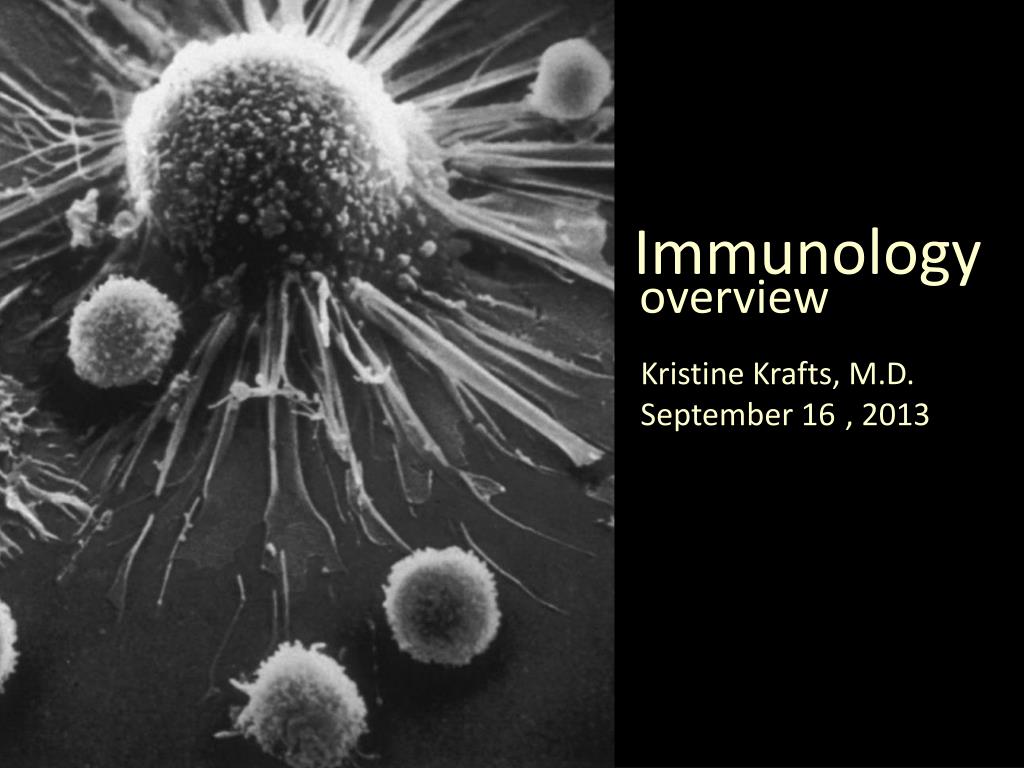
Immunology. overview. Kristine Krafts, M.D. September 16 , 2013. A hairy person (or someone who doesn ’ t mind being hairy). Dendritic cell. Dendritic cell. Hairy projections Eats bugs Presents antigens. An indiscriminate bully. Natural killer cell. Natural killer cell. A brute
Une image / un lien ci-dessous est fourni (tel quel) pour télécharger la présentation
Politique de téléchargement : le contenu du site vous est fourni TEL QUEL pour votre information et votre usage personnel ; il ne peut être vendu, concédé sous licence ni partagé sur d’autres sites sans l’accord de son auteur.Le contenu vous est fourni TEL QUEL, pour votre information et votre usage personnel uniquement.Téléchargez la présentation en cliquant sur ce lien.Lors du téléchargement, si vous ne parvenez pas à télécharger une présentation, l’éditeur a peut-être supprimé le fichier de son serveur.Pendant le téléchargement, si vous ne parvenez pas à obtenir une présentation, le fichier a peut-être été supprimé par l’éditeur.
F I N
Plus de contenu associé
Transcription de la présentation
Immunology overview Kristine Krafts, M.D. September 16 , 2013
Definitions • Immunity = protection against infections • Immune system = collection of cells and molecules that defend us against microbes • Immune deficiencies → infections • Immune excesses → autoimmune diseases
Innate (Natural) Immunity • Always present (innate); doesn’t change over time • First line of defense when bugs come • Major components: • Epithelial barriers (skin, GI, respiratory) • NK cells • Complement
Adaptive (Acquired) Immunity • Second line of defense • More specific (adaptive) and powerful than innate • Major components: • Lymphocytes • Lymphocyte products • Two types of adaptive immunity: • Humoral immunity (mediated by antibodies) • Cellular immunity (mediated by T cells)
Lymphocytes • Present in lymphoid organs and in blood • Groups • T-lymphocytes (grow up in thymus) • B-lymphocytes (grow up in bone marrow) • Each one has receptors for a specific antigen • Recognize millions of different antigens! • Diversity generated by: • rearrangement of antigen receptor genes • different joining of the gene segments • Gene rearrangement studies
T-Lymphocytes • Live in blood, bone marrow, lymphoid tissues • Two basic functions: • kill stuff • help other cells do their jobs • T-cell receptor (TCR) complex recognizes antigens • binds antigen • sends signals to the T cell • Antigens must be: • displayed by other cells… • …AND bound to an MHC receptor
T-Lymphocytes • Helper T cells • CD4+ (and CD8-) • help B cells make antibodies • help macrophages eat bugs • Cytotoxic T cells • CD8+ (and CD4-) • kill virus-infected cells and tumor cells
MHC • Collection of genes on chromosome 6 • Three regions: class I, class II, class III • Highly polymorphic! • Gene products: • class I molecules • class II molecules • class III molecules (and other stuff) Major histocompatibility (MHC) complex
class II MHC genes class III MHC genes class I MHC genes class II MHC molecule class I MHC molecule
MHC • Encoded by three loci: HLA-A, HLA-B, HLA-C • Display antigens from within the cell (e.g., viral antigens) to CD8+ T cells. • Present on all nucleated cells! (Good idea.) Class I MHC molecules
MHC • Encoded by three loci: HLA-DP, HLA-DQ, HLA-DR • Display extracellular antigens (e.g., bacterial antigens the cell has eaten) to CD4+ T cells • Present mainly on antigen presenting cells, like macrophages! (Makes sense.) Class II MHC molecules
B-Lymphocytes • Live in blood, bone marrow, lymphoid tissues • Basic function: make antibodies (immunoglobulins) • B-cell receptor complex recognizes antigens • binds antigen • sends signals to T cells • Antigens can be free and circulating (don’t have to be bound to MHCs or displayed by other cells to be recognized!)
Natural Killer Cells • Belong to innate immunity arm • No highly variable receptors like T and B cells • Main job: recognize and kill damaged or infected cells • Antigens can be free and circulating (don’t have to be bound to MHCs or displayed by other cells to be recognized!)