Download
1 / 17
170 likes | 323 Vues
This summary explores the fundamental differences between SN1, SN2, E1, and E2 reactions involving alkyl halides. It discusses the reaction conditions that favor either substitution (SN) or elimination (E), emphasizing the role of nucleophiles and bases. Key factors such as substrate structure and concentration are analyzed to predict product outcomes and distributions. The advantages of using hindered alkyl halides for alkene synthesis and the effects of ring formation in intramolecular vs. intermolecular reactions are also highlighted, providing essential insights for effective synthetic strategies.

E N D
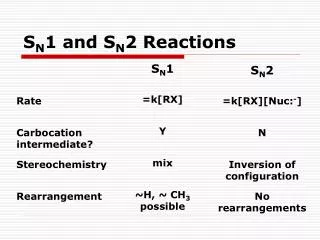
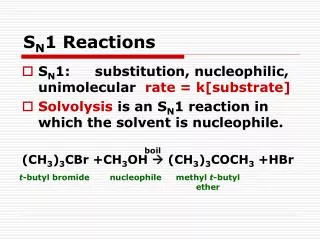
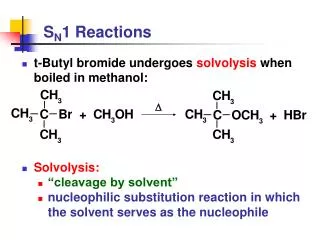
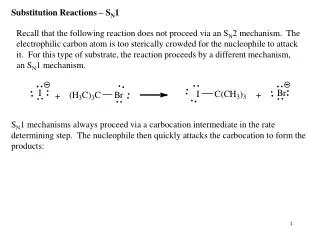
Substitution vs. Elimination Alkyl halides can undergo SN2, SN1, E2 and E1 Reactions • 1) Which reaction conditions favor SN2/E2 or SN1/E1? • SN2/E2 reactions are favored by a high • concentration of nucleophile/strong base • SN1/E1 reactions are favored by a poor • nucleophile/weak base 2) What will be the relative distribution of substitution product vs. elimination product?
Consider SN1/E1 vs. SN2/E2 Consider the Substrate
Returning to Sn2 and E2:Considering the differences Can you predict the products? Can you explain the products?
A hindered alkyl halide should be used if you want to synthesize an alkene
Intermolecular vs. Intramolecular Reactions • A low concentration of reactant favors an intramolecular • reaction • The intramolecular reaction is also favored when a five- • or six-membered ring is formed
Three- and four-membered rings are less easily formed Three-membered ring compounds are formed more easily than four-membered ring compounds The likelihood of the reacting groups finding each other decreases sharply when the groups are in compounds that would form seven-membered and larger rings.