Muscular System
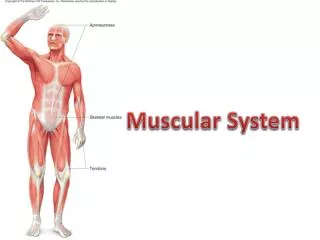
Muscular System. Muscular Syste m. Muscles use chemical energy to exert a pulling force Many functions Movement of body parts Propel body fluids and food Heartbeat Distribute heat Protects body. Types of Muscle. Smooth Muscle Cardiac Muscle Skeletal Muscle. Smooth Muscle.

Muscular System
E N D
Presentation Transcript
Muscular System • Muscles use chemical energy to exert a pulling force • Many functions • Movement of body parts • Propel body fluids and food • Heartbeat • Distribute heat • Protects body
Types of Muscle • Smooth Muscle • Cardiac Muscle • Skeletal Muscle
Smooth Muscle • Peristalsis, vasoconstriction • No Striations • Single nucleus • No Transverse Tubules • No Intercalated Discs • Involuntary • Tapered
Cardiac Muscle • Heartbeat • Striations • Single nucleus • Transverse Tubules • Intercalated Discs • Involuntary • Branched
Skeletal Muscle • Movement of bones at joints • Striations • Multiple nuclei • Transverse Tubules • No Intercalated Discs • Voluntary • Non-Branched
Levers • Skeletal muscles act as levers • Levers are simple mechanical devices consisting of a • Rod • Fulcrum • Weight (Resistance) • Force Applied
1st Class Lever • Fulcrum located between resistance and force • Ex. Extending the arm at the elbow
2nd Class Lever • Resistance located between fulcrum and force • Ex. Opening mouth at mandible
3rd Class Lever • Force located between resistance and fulcrum • Ex. Flexing arm at the elbow
Features of Muscle • Origin – The head of the muscle, usually superior, relatively immobile • Insertion – The end of the muscle, usually inferior, relatively mobile • When a muscle contracts, the insertion is moved towards the origin
Muscle Interactions • Agonist – A muscle that causes an action • Ex. Deltoid is the agonist for abduction of arm • Antagonist – A muscle that opposes an action • Ex. Pectoralis Major is the antagonist for abduction of arm • Synergist – Muscles that work together • Prime Mover – The muscle that does most of the work in synergistic relationships
Types of Movements • Flexion – Moving parts at a joint, angle decreases • Extension – Moving parts at a joint, angle increases • Hyperextension – Extension beyond anatomical position
Dorsiflexion – Moving ankle closer to shin • Plantar Flexion – Moving ankle further from shin
Abduction – Moving a body part away from the midline of the body • Adduction – Moving a body part towards the midline of the body, think ADDuction= ADDing to body
Medial Rotation – Turning a limb on its axis towards the midline of the body • Lateral Rotation – Turning a limb on its axis away from the midline of the body
Circumduction – Moving a body part so that it follows a circular path
Pronation – Rotation of forearm so that the palm is facing downward • Supination – Rotation of forearm so that the palm is facing upward, think “holds soup”
Eversion – Turning the foot so the bottom faces laterally • Inversion – Turning the foot so the bottom faces medially
Protraction – Moving a body part forward • Retraction – Moving a body part backward
Elevation – Raising a part of the body • Depression – Lowering a part of the body