
SlideServe
Menu
Préférences
© SlideServe · v2026

Enhancing Conversational Speech Quality of VoIP in a Wired/Wireless Environment

tracen avatar
1 diapositives · 149 Views · Oct 09, 2014

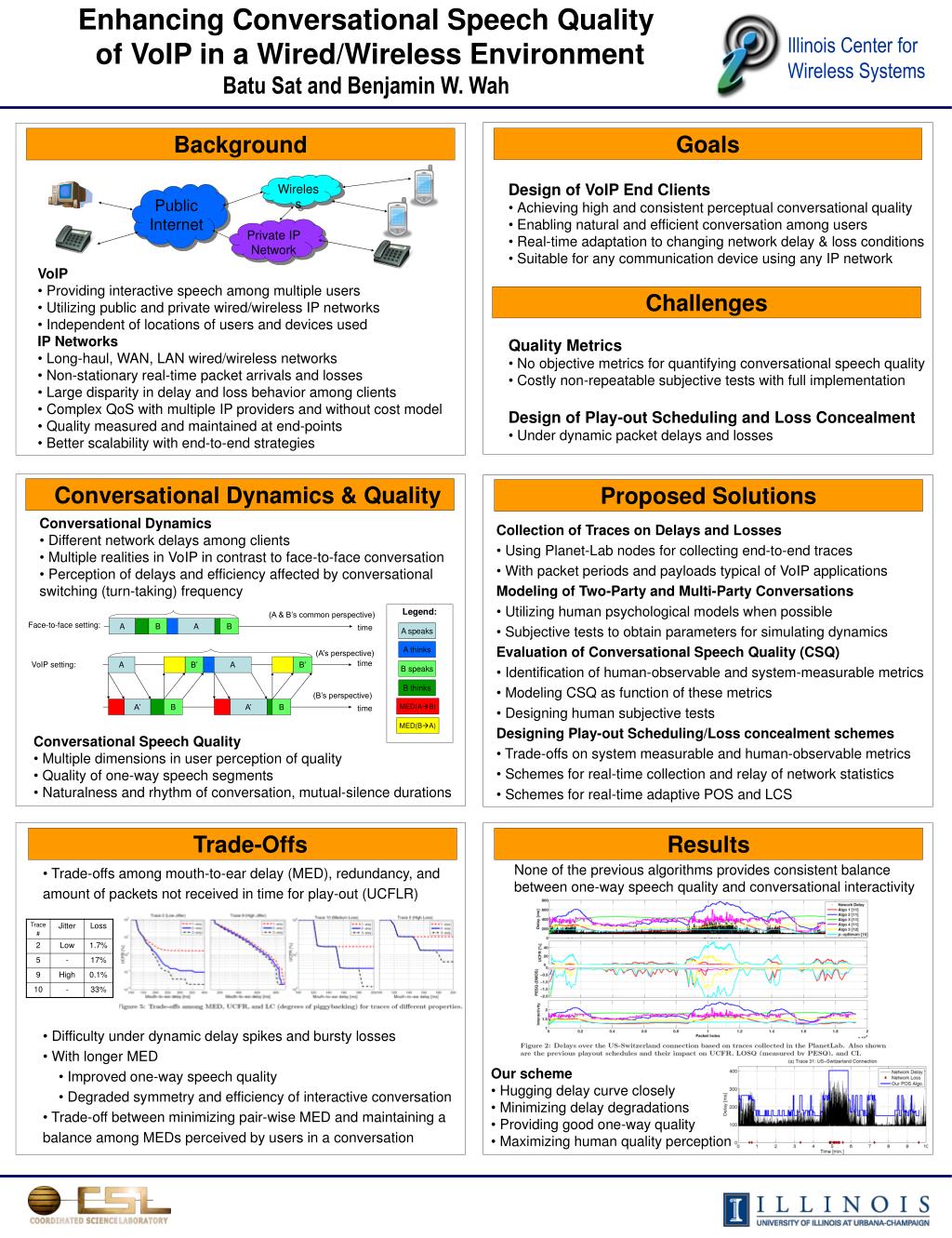
This paper explores the enhancement of conversational speech quality in Voice over IP (VoIP) settings across wired and wireless networks. It highlights design considerations for VoIP end clients, including achieving high perceptual quality, real-time network adaptation, and interactions among multiple users. Key challenges include the lack of objective metrics for conversational quality and dynamic network conditions. Proposed solutions focus on leveraging conversational dynamics, delay perception, and real-time adaptive schemes to optimize user experience.
Enhancing Conversational Speech Quality of VoIP in a Wired/Wireless Environment - slide 1
01 / 1Enhancing Conversational Speech Quality of VoIP in a Wired/Wireless Environment
1 / 17

Télécharger la présentation

Enhancing Conversational Speech Quality of VoIP in a Wired/Wireless Environment
Une image / un lien ci-dessous est fourni (tel quel) pour télécharger la présentation

Politique de téléchargement : le contenu du site vous est fourni TEL QUEL pour votre information et votre usage personnel ; il ne peut être vendu, concédé sous licence ni partagé sur d’autres sites sans l’accord de son auteur.Le contenu vous est fourni TEL QUEL, pour votre information et votre usage personnel uniquement. Téléchargez la présentation en cliquant sur ce lien. Lors du téléchargement, si vous ne parvenez pas à télécharger une présentation, l’éditeur a peut-être supprimé le fichier de son serveur.Pendant le téléchargement, si vous ne parvenez pas à obtenir une présentation, le fichier a peut-être été supprimé par l’éditeur.

F I N

Plus de contenu associé

Transcription de la présentation
  1. Enhancing Conversational Speech Quality of VoIP in a Wired/Wireless Environment Batu Sat and Benjamin W. Wah Wireless Public Internet Private IP Network Legend: (A & B’s common perspective) Face-to-face setting: A B A B time A speaks A thinks (A’s perspective) A B’ A B’ time VoIP setting: B speaks B thinks (B’s perspective) MED(AB) A’ B A’ B time MED(BA) Illinois Center for Wireless Systems Goals Background • Design of VoIP End Clients • Achieving high and consistent perceptual conversational quality • Enabling natural and efficient conversation among users • Real-time adaptation to changing network delay & loss conditions • Suitable for any communication device using any IP network • VoIP • Providing interactive speech among multiple users • Utilizing public and private wired/wireless IP networks • Independent of locations of users and devices used • IP Networks • Long-haul, WAN, LAN wired/wireless networks • Non-stationary real-time packet arrivals and losses • Large disparity in delay and loss behavior among clients • Complex QoS with multiple IP providers and without cost model • Quality measured and maintained at end-points • Better scalability with end-to-end strategies Challenges • Quality Metrics • No objective metrics for quantifying conversational speech quality • Costly non-repeatable subjective tests with full implementation • Design of Play-out Scheduling and Loss Concealment • Under dynamic packet delays and losses • Conversational Dynamics & Quality Proposed Solutions • Conversational Dynamics • Different network delays among clients • Multiple realities in VoIP in contrast to face-to-face conversation • Perception of delays and efficiency affected by conversational switching (turn-taking) frequency • Collection of Traces on Delays and Losses • Using Planet-Lab nodes for collecting end-to-end traces • With packet periods and payloads typical of VoIP applications • Modeling of Two-Party and Multi-Party Conversations • Utilizing human psychological models when possible • Subjective tests to obtain parameters for simulating dynamics • Evaluation of Conversational Speech Quality (CSQ) • Identification of human-observable and system-measurable metrics • Modeling CSQ as function of these metrics • Designing human subjective tests • Designing Play-out Scheduling/Loss concealment schemes • Trade-offs on system measurable and human-observable metrics • Schemes for real-time collection and relay of network statistics • Schemes for real-time adaptive POS and LCS • Conversational Speech Quality • Multiple dimensions in user perception of quality • Quality of one-way speech segments • Naturalness and rhythm of conversation, mutual-silence durations • Trade-Offs Results • None of the previous algorithms provides consistent balance between one-way speech quality and conversational interactivity • Trade-offs among mouth-to-ear delay (MED), redundancy, and amount of packets not received in time for play-out (UCFLR) • Difficulty under dynamic delay spikes and bursty losses • With longer MED • Improved one-way speech quality • Degraded symmetry and efficiency of interactive conversation • Trade-off between minimizing pair-wise MED and maintaining a balance among MEDs perceived by users in a conversation • Our scheme • Hugging delay curve closely • Minimizing delay degradations • Providing good one-way quality • Maximizing human quality perception