Download
1 / 22
220 likes | 386 Vues
This overview explores the various forms of imperialism, detailing how countries extend their authority through colonization, economic dominance, and political control. It defines key concepts such as colonies—in which foreign powers govern territories internally—protectorates that maintain local governments under external control, and spheres of influence where outside powers claim exclusive trading privileges. Additionally, the economic aspect of imperialism is examined, where private business interests dominate local economies. Management methods under imperialism, including indirect and direct control, are also highlighted.

E N D
FORMS OF IMPERIALISM Imperialism is a policy in which one country seeks to extend its authority by conquering other countries or by establishing economic and political dominance over other countries
COLONY • A Colony is a country or territory governed internally by a foreign power: • Ex.) In 1819, Great Britain, under Sir Thomas Stamford Raffles, founded a new colony at the tip of the Malay Peninsula – Singapore (“city of the Lion”) – becomes a major stopping point going to or from China.
PROTECTORATE • A country or a territory with its own internal government but under the control of an outside power: • Ex.) Vietnam: To stop the British form monopolizing trade in S.E. Asia, in 1857 France will force the Vietnamese to accept French protection and will occupy Saigon (south) for 30 years - extending control over the country. In 1884 France seizes Hanoi (north) making the Vietnamese Empire a French Protectorate.
By the 1880’s France extended it’s controlled over Cambodia, Annam, Tonkin, & Laos • THE UNION OF FRENCH INDOCHINA
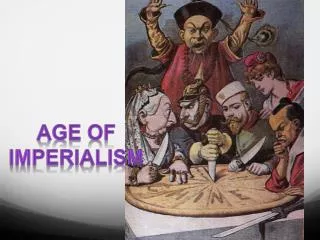
SPHERE OF INFLUENCE • An area in which an outside power claims exclusive investment or trading privileges • Ex) Chinese warlords in provinces negotiate directly with foreign nations. In return for money warlords grant exclusive trading rights or RR building and mining privileges. • Britain, France, Germany, Russia, & Japan all establish spheres of influence in China.
ECONOMIC IMPERIALISM • Private business interests control an independent but less developed country instead of it’s government • Ex) 1887- American settlers gain control of the sugar industry on the Hawaiian Islands. Over throw the monarchy of Queen Liliuokalani
IMPERIALISM MANAGEMENT METHODS • INDIRECT CONTROL • Local government officials used • Limited self-rule • Goal: develop future leaders • Government institutions are based on European styles, but may have local rules
Ex) British in Nigeria • Relied on existing political leaders • Local officials handled daily management of colony • Colony had a legislative council that included colonial officials, merchants, & professionals • Councils train local leaders in British method of government • In time the local population would govern itself (as in Canada & Australia)
DIRECT CONTROL • Foreign officials brought in to rule • No self-rule • Goal – assimilation • Government institutions are based on European styles