Future of HIPERLAN Type 1: Challenges, Standards, and Market Dynamics
20 likes | 133 Vues
This document discusses the future of HIPERLAN Type 1 in relation to other wireless standards. It highlights the unsuitability of HIPERLAN Type 1 for public access by operators and the decline in vendor interest. It notes that Bluetooth has absorbed some of the intended services. A call for a harmonized channel raster is emphasized due to the ERC decision, and the necessity for changes in the MAC is acknowledged. The document advocates for unrestricted use of IEEE 802.11a in Europe under the RTTE directive, stressing the importance of compliance with ERC.


Future of HIPERLAN Type 1: Challenges, Standards, and Market Dynamics
E N D
Presentation Transcript
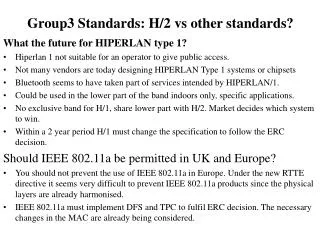
Group3 Standards: H/2 vs other standards? What the future for HIPERLAN type 1? • Hiperlan 1 not suitable for an operator to give public access. • Not many vendors are today designing HIPERLAN Type 1 systems or chipsets • Bluetooth seems to have taken part of services intended by HIPERLAN/1. • Could be used in the lower part of the band indoors only, specific applications. • No exclusive band for H/1, share lower part with H/2. Market decides which system to win. • Within a 2 year period H/1 must change the specification to follow the ERC decision. Should IEEE 802.11a be permitted in UK and Europe? • You should not prevent the use of IEEE 802.11a in Europe. Under the new RTTE directive it seems very difficult to prevent IEEE 802.11a products since the physical layers are already harmonised. • IEEE 802.11a must implement DFS and TPC to fulfil ERC decision. The necessary changes in the MAC are already being considered.
Many vendors are implementing the IEEE 802.11a products. • Co-ordination between ERC and IEEE is needed to verify the ERC requirements. With or without complying to the ERC decision? • UK and other european countries should comply with ERC. What restrictions should apply? • The ERC decision should apply. • A harmonised channel raster like the 20 MHz channels used by H/2, IEEE and MMAC should be required. Note that this is already a requirement in Japan.