Reproduction Systematics and Taxonomy
180 likes | 294 Vues
This overview covers key reproductive strategies in animals, including oviparity and viviparity, with examples like cnidarians, sharks, and mammals. It differentiates between direct and indirect development, highlighting the significance of larval stages for dispersal. The text also delves into the history and principles of biological taxonomy, focusing on the Linnaean hierarchy and contemporary practices in species description. Approximately 6,200 new species are documented yearly, showcasing the dynamic nature of systematics and the ongoing discovery in zoological diversity.


Reproduction Systematics and Taxonomy
E N D
Presentation Transcript
ReproductionSystematics and Taxonomy BIOL240.002 Zoology 22 September 2014
Oviparity • Eggs laid by ♀ • External fertilizers • Many internal fertilizers • Planktonic eggs: Eggs drift about in water • Ex: Most cnidarians • Ex: Most echinoderms • Egg masses: • Ex: Frogs Fig. 7.10 p. 139 Fig. 17.16 p. 363
Oviparity • Protective/Nutritive deposition of eggs: • Ex: Ichneumon wasps • Ex: Some sharks’ “mermaid’s purses” • Ex: Turtle nests Fig. 13.46 p. 274
Oviparity • Brooding: one or both parents tending to eggs in/on body or in nest • Ex: Bryozoans • Ex: Some salamanders and caecilians • Ex: Crocodilians • Ex: Birds Fig. 9.4 p. 179 Fig. 17.6 p. 357 Fig. 17.4 p. 357
Viviparity • Live bearing of young • Fewer young/Higher survival • Aplacentalviviparity • aka Lecithotrophy • aka Ovoviviparity • Ex: Some sharks • Ex: Some snakes and lizards • Placentalviviparity • aka Matrotrophy • Ex: Some sharks • Ex: Velvet worms • Ex: Most caecilians • Ex: A few snakes • Ex: Almost all mammals
Seahorse Male “Pregnancy” • A father seahorse “giving birth” • Female deposits ova in his brood pouch • Egg brooding that resembles pregnancy
Direct Development • Juveniles resemble adults • Ex: Velvet worms • Ex: Reptiles • Common in terrestrial animals • Major exception: Winged insects
Indirect Development • Young hatch or are born as larvae which will undergo metamorphosis • Ancestral condition in Animalia • Important for dispersal in animals whose adults are sessile, parasitic, or otherwise have limited mobility • Some animals pass through multiple larval stages • Ex: Three in mussels (trocophore, veliger, glochidium) • Ex: Four in liver fluke (miracidium, sporocyst, redia, cercaria) Fig. 8.10 p. 162 Figs. 10.6, 10. 7, 10.30 pp. 191-205
Development in the Hexapoda • Primitive wingless hexapods: Direct • Ex: Silverfish • Incomplete metamorphosis • Nymph or naiad undergoes metamorphosis but looks much like adult • Ex: Mayfly • Ex: Stonefly • Complete metamorphosis • Larva looks little like adult it will become • Ex: Maggot Fly • Ex: Grub Beetle • Ex: Caterpillar Butterfly Fig. 13.60 p. 282 Fig. 13.61 p. 282 Fig. 13.47 p. 274
Early Biological Taxonomy • Modern system originated in late 1500s • Latin: Universal language of science • Names were initially polynomials • Descriptive of the species they named • Ex: Apispubescensthoracesubgriseoabdominefuscopedibusposticusglabrisutrinquemargineciliatis • (European honeybee) • Some early naturalists experimented with shorter names
Karl von Linne • aka CarolusLinneaus • Swedish botanist (1707–1778) • 1735: 1st ed. of SystemaNaturae • Named and described plants and animals • Polynomials • 1758: 10th ed. • Binomials • Ex: Apismellifera • Named and described 7700 spp. of plants and 4400 spp.of animals in his lifetime Fig. 4.1 p. 77
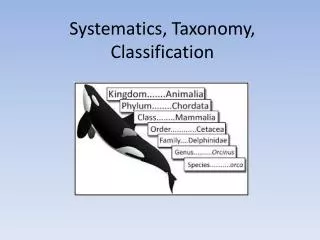
The Linnean Hierarchy • Also used in the 10th ed. of SystemaNaturae • KCOGS • Soon, P and F added • KPCOFGS
Obligate and NonobligateLevels of Taxonomy • Obligate Levels: KPCOFGS • Domain, too, since 1990 • Non-obligate levels • Inserted between the obligate levels • Used in taxa that have many spp., to sort out their diversity • Ex: Order Coleoptera—400,000 spp. • Suborder Adephaga—9 families • ground and tiger beetles, whirligigs, etc. • Suborder Archestomata—5 families • reticulated and telephone-pole beetles, etc. • Suborder Myxophaga—4 families • skiff beetles, etc. • Suborder Polyphaga—148 families • contains a total of 5 infraorders and 16 superfamilies Fig. 4.9 p. 90
The Linnean Taxonomic Hierarchy Table 4.1 p. 78
Describing New Species • Lately, ~6200 new species names and descriptions are published annually (all taxa) • Type specimen in a museum • Detailed description along with name in print • Avg. taxonomist: ~25 spp. in a career • 1,244,360 spp. of organisms have been described (2011 compilation) • 8,118 protozoans (2014 Catalogue of Life: 12,695) • 953,434 animals (2014: 1,088,043) • 215,644 plants (2014: 342,914) • On average, taxonomic specialists estimate 18% of species names are invalid synonyms of previously-described species