VERA project
The VERA project, a cutting-edge astrometry initiative, celebrates its 10th anniversary at the VLBA conference held in Socorro, New Mexico, on June 12, 2003. This collaboration involves 13 scientists and numerous technicians and graduate students from various institutions, including NAOJ and Kagoshima University. The project aims to achieve high-precision measurements of astrometry, proper motion, and parallax using a sophisticated network of antennas, facilitating a detailed 3D mapping of the Galaxy and improving understanding of the Milky Way's molecular gas structures.

VERA project
E N D
Presentation Transcript
VERAproject H.Kobayashi NAOJ,VERA project VLBA 10th Anniversary Conference (Socorro, June 12, 2003)
Project members • 13 scientists (NAOJ, Kagoshima Univ.) • H.Kobayashi, S.Manabe, N.Kawaguchi, T.Omodaka, K.Shibata, O.Kameya, Y.Tamura, M.Honma, K.Hirota, Y.Kanya, T.Jike, H. Ishituka, M.Rijoha • 7 technicians • T.Miyaji, K.Horiai, S.Kuji, K.Iwadate, K.Satou, H.Sakai, T.Bushimata • 8 graduate students • T.Oyama, T.Kurayama, R.Kamohara, H.Suda, S.Sakakibara, K.Nakashima, R.Shimizu, Y.Che
Scientific goal • Astrometry with 10μarcsec. accuracy between background object and galactic object within 2.2 degree separation • Proper motion and parallax measurements • 3D map and velocity field of the Galaxy • Detailed 3D velocity structure of molecular gas around evolved stars and star forming regions • Phase referencing to improve sensitivity with long integration
Expected distance accuracy of VERA Sun 10% error at the G.C 20% error at opposite side
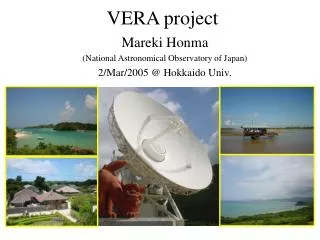
Specifications • Antenna diameter ; 20m • Observing bands ; 2GHz, 8GHz, 22GHz、43GHz • Tape recording rate ; 1Gbps • 2 beam system for phase referencing • Path error between 2 beam; 100μm
Construction of the antenna • Panel adjustment • Surface accuracy • 0.15mm rms • Panel; 0.1 mm rms • Panel adjustment; 0.1 mm rms • Sub ref.: 0.03mm rms
Cooled HEMT receiver Trx = 60 K @ 22GHz 40K@22GHz Trx=130K @43GHz 70K@43GHz Discrete HEMT MMIC HEMT
Radiator on the antenna surface • Noise source on the dish • Symmetric distribution of 4 noise sources • Instrumental phase error is estimated by the average of 4.
Instrumentalphase correction • Phase difference of surface radiator between 2 beams • Less than 1degreemeasurement accuracy is achieved 2B phase response from surface radiator depend on beam separation
First phase variations between 2 beams Fringe phase of W49N,OH43 and difference Allan variance of them
Coherence improvement Coherence drop of 1B and 2B fringe Fringe detection with 20 min. integration, GRB030329
Digital backend • 2.4Gbps transmit for each beam • Digital filter is used for frequency selection
Fringe detection by SX mode Nov. 19th, 2002 between VERA mizusawa- Gifu
Geodesy observations • Combine with the world coordinate by SX observations • Combined with Tsukuba 32m of Japanese GSI • Baseline determination • Required accuracy2mm • 22GHz wideband observations • SX conventional observations
VERA first fringe on Feb. 20th, 2002 Orion-KL H2O maser
1Gbps recorder & correlation • SONYDIR20001024Mbps • 80 min/tape • Mitaka FX correlator • 5 station correlation with 1Gbps • Output to CODA system • Convert correlation data to FITS
First 1Gbps fringe among VERA 4 stations, Sep. 18th, 2002 IrーIs OgーIs Mz-Is Mz-Ir
Test observations • Phase referencing check • 22GHz • SgrB2-SgrA*, W51N, W49N, Orion-KL, W3OH • VX-Sgr, VY-CMa, etc • 43GHz • Orion-KL • Fringe check and calibrators • Strong H2O masers (>20Jy), • Calibrator candidates
Expected sensitivity 1 * Measured value
VERA Mizusawa met a strong earthquake (Sanriku-minami jishin) Vertical 0.2G, Horizontal 0.3G
Plan of VERA 2002: Fringedetection / 2B fringe test 2003: Feasibility check of 2B interferometer Test observations for astrometry 2004: Test observations for astrometry Improvement of system sensitivity 2005: Complete
VERA & KVN Network Mizusawa KVN VERA Iriki Ogasawara Ishigakijima
16 VLBI stations in east Asia Under operation Under construction