Understanding Carboxylic Acids: Structure, Nomenclature, and Reactions
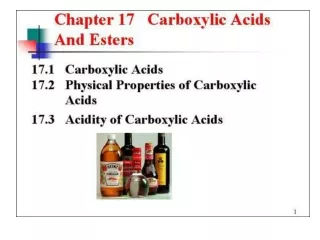
This overview focuses on carboxylic acids, detailing their structure, bonding, and unique properties. With an emphasis on electron delocalization, we explore how this stabilization affects acidity and the significance of hydrogen-bonded dimers in phase behavior. Carboxylic acids are systematically named following IUPAC rules, replacing the "-e" ending of alkanes with "oic acid." The text also covers the reactions of carboxylic acids, including esterification and decarboxylation, alongside their physical properties such as solubility and acidity.

Understanding Carboxylic Acids: Structure, Nomenclature, and Reactions
E N D
Presentation Transcript
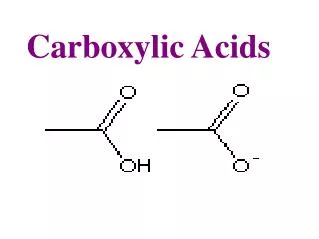
– •• •• R O R O + •• •• •• C C O O •• •• •• •• H H Electron Delocalization
– – •• •• •• R O R O R O + •• •• •• •• •• C C C + O O O •• •• •• •• •• H H H Electron Delocalization • stabilizes carbonyl group
Formic acid is planar O H C O 120 pm H 134 pm
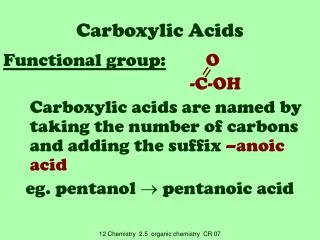
O HCOH O CH3COH O CH3(CH2)16COH NOMENCLATURE • systematic IUPAC names replace "-e" ending of alkane with "oic acid" Systematic Name methanoic acid ethanoic acid octadecanoic acid
O HCOH O CH3COH O CH3(CH2)16COH NOMENCLATURES • common names are based on natural origin rather than structure Systematic Name Common Name methanoic acid formic acid ethanoic acid acetic acid octadecanoic acid stearic acid
O CH3CHCOH O OH CH3(CH2)7 (CH2)7COH C C H H NOMENCLATURE Systematic Name Common Name 2-hydroxypropanoicacid lactic acid (Z)-9-octadecenoicacid oleic acid
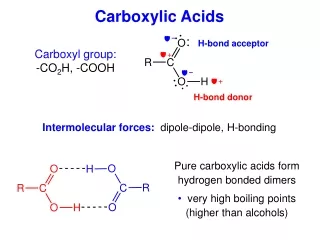
O O H CCH3 H3CC O H O Hydrogen-bonded Dimers • Acetic acid exists as a hydrogen-bonded dimer in the gas phase. The hydroxyl group of each molecule is hydrogen-bonded to the carbonyl oxygen of the other.
Hydrogen-bonded Dimers • Acetic acid exists as a hydrogen-bonded dimer in the gas phase. The hydroxyl group of each molecule is hydrogen-bonded to the carbonyl oxygen of the other.
H O O H H3CC H O H O H Solubility in Water • carboxylic acids are similar to alcohols in respect to their solubility in water • form hydrogen bonds to water
O RC O d+ – •• •• O O •• •• •• RC RC •• – O O •• •• •• •• Greater acidity of carboxylic acids is attributedstabilization of carboxylate ion by inductive effect of carbonyl group – resonance stabilization of carboxylate ion
O O HOC COH O O HOCCH2COH O O HOC(CH2)5COH Dicarboxylic Acids pKa • one carboxyl group acts as an electron-withdrawing group toward the other; effect decreases with increasing separation Oxalic acid 1.2 Malonic acid 2.8 Heptanedioic acid 4.3
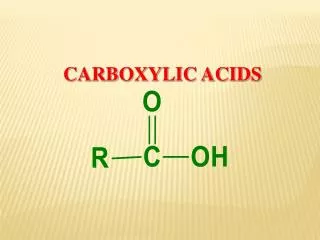
Reactions of Carboxylic Acids • Acidity • Reduction • Esterification • Reaction with Thionyl Chloride
Reactions of Carboxylic Acids • a-Halogenation • Decarboxylation • But first we revisit acid-catalyzed esterificationto examine its mechanism. New reactions in this chapter
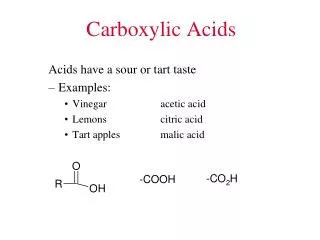
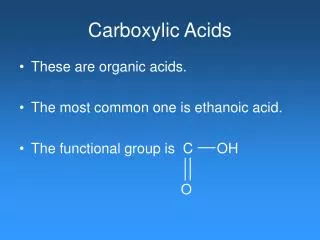
Acidity of Carboxylic Acids • Most carboxylic acids have a pKa close to 5.
O CH3COH Carboxylic acids are weak acids • but carboxylic acids are far more acidic than alcohols CH3CH2OH Ka = 1.8 x 10⁻⁵ pKa = 4.7 Ka = 10-16 pKa = 16
O CH2COH X X Ka pKa H 1.8 x 10⁻⁵ 4.7 2.5 x 10⁻³ 2.6 F Cl 1.4 x 10⁻³ 2.9 Substituent Effects on Acidity • electronegative substituents increase acidity
O O Carboxylic acids are neutralized by strong bases • equilibrium lies far to the right; K is ~ 1011 • as long as the molecular weight of the acid is not too high, sodium and potassium carboxylate salts are soluble in water + + RCOH HO– RCO– H2O strongeracid weakeracid
O O CH3(CH2)16CO Micelles • unbranched carboxylic acids with 12-18 carbonsgive carboxylate salts that form micelles inwater ONa sodium stearate(sodium octadecanoate) – Na+
O Micelles • sodium stearate has a polar end (the carboxylate end) and a nonpolar "tail" • the polar end is "water-loving" or hydrophilic • the nonpolar tail is "water-hating" or hydrophobic • in water, many stearate ions cluster together to form spherical aggregates; carboxylate ions on the outside and nonpolar tails on the inside ONa polar nonpolar
O O R2CCOH R2CCOH H X a -Halogenation of Carboxylic Acids • analogous to a-halogenation of aldehydes and ketones • key question: Is enol content of carboxylic acids high enough to permit reaction to occur at reasonable rate? (Answer is NO) + + X2 HX
O O Br2 CH3CH2CH2COH CH3CH2CHCOH P Br (77%) Reactions • a-Halogen can be replaced by nucleophilic substitution
O RCOH O O O CH3COH HOCCH2COH Decarboxylation of Carboxylic Acids Simple carboxylic acids do not decarboxylatereadily. + RH CO2 But malonic acid does. 150°C + CO2
O RC X Acyl Halides • name the acyl group and add the word chloride, fluoride, bromide, or iodide as appropriate • acyl chlorides are, by far, the most frequently encountered of the acyl halides
O CH3CCl O H2C CHCH2CCl O F CBr Acyl Halides acetyl chloride 3-butenoyl chloride p-fluorobenzoyl bromide
O O RCOCR' Acid Anhydrides • when both acyl groups are the same, name the acid and add the word anhydride • when the groups are different, list the names of the corresponding acids in alphabetical order and add the word anhydride
O O CH3COCCH3 O O C6H5COCC6H5 O O C6H5COC(CH2)5CH3 Acid Anhydrides acetic anhydride benzoic anhydride benzoicheptanoic anhydride
O O O O CH3COCCH3 O O O O Some anhydrides are industrial chemicals Aceticanhydride Phthalicanhydride Maleicanhydride
O RCOR' Esters • name as alkyl alkanoates • cite the alkyl group attached to oxygen first (R') • name the acyl group second; substitute the suffix -ate for the -ic ending of the corresponding acid
O CH3COCH2CH3 O CH3CH2COCH3 O COCH2CH2Cl Esters ethyl acetate methyl propanoate 2-chloroethylbenzoate
O CH3COCH2CH2CH(CH3)2 Esters are very common natural products • also called "isopentyl acetate" and "isoamyl acetate" • contributes to characteristic odor of bananas 3-methylbutyl acetate
Lactones • Lactones are cyclic esters • Formed by intramolecular esterification in acompound that contains a hydroxyl group anda carboxylic acid function
O O HOCH2CH2CH2COH O Examples • IUPAC nomenclature: replace the -oic acidending of the carboxylic acid by-olide • identify the oxygenated carbon by number + H2O 4-hydroxybutanoic acid 4-butanolide
O O O O Common names a b a • Ring size is designated by Greek letter corresponding to oxygenated carbon • A g lactone has a five-membered ring • A d lactone has a six-membered ring b g g d g-butyrolactone d-valerolactone
O RCNH2 Amides having an NH2 group • identify the corresponding carboxylic acid • replace the -ic acid or -oic acid ending by - amide.
O CH3CNH2 O (CH3)2CHCH2CNH2 O CNH2 Amides having an NH2 group acetamide 3-methylbutanamide benzamide
O O RCNHR' RCNR'2 Amides having substituents on N • name the amide as before • precede the name of the amide with the name of the appropriate group or groups • precede the names of the groups by the letter N- (standing for nitrogen and used as a locant) and
O CH3CNHCH3 O CN(CH2CH3)2 O CH3CH2CH2CNCH(CH3)2 CH3 Amides having substituents on N N-methylacetamide N,N-diethylbenzamide N-isopropyl-N-methylbutanamide
RC N Nitriles • add the suffix -nitrile to the name of the parent hydrocarbon chain (including the triply bonded carbon of CN) • or: replace the -ic acid or -oic acid name of the corresponding carboxylic acid by -onitrile • or: name as an alkyl cyanide (functional class name)
CH3C N C6H5C N CH3CHCH3 C N Nitriles ethanenitrileor: acetonitrileor: methyl cyanide benzonitrile 2-methylpropanenitrileor: isopropyl cyanide