Download
1 / 8
80 likes | 191 Vues
Today's lesson explores the fascinating structure and function of DNA, the deoxyribonucleic acid that serves as the genetic blueprint for all living organisms. We will discuss how DNA can be replicated due to its double helix structure, which allows it to "unzip" for copying. Additionally, we will answer questions on DNA's significance, such as its role in determining physical traits in offspring and its presence in every cell's nucleus. Join us in diving into the basics of genetics and cellular biology!

E N D
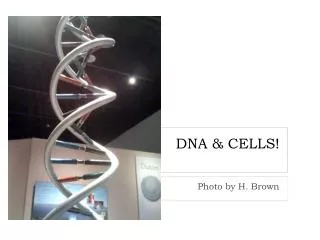
DNA & CELLS! Photo by H. Brown
Today’s Bellwork • DNA can be reproduced because of its STRUCTURE • The Double Helix can be “unzipped,” so that each strand can be copied. • http://www.youtube.com/watch?v=teV62zrm2P0
Why is DNA important? Why does a baby elephant have a trunk? What makes a giraffe baby look like its mom and not an elephant?
CELL • The basic unit of life
DNA • DNA—deoxyribonucleic acid: the genetic blueprint or instructions contained in every cell of an organism • Polymer—large molecule formed when many smaller molecules bond together • The genetic material that allows traits to be passed down from Parent (P1) Offspring (F1)
What is DNA made of? • Nucleotides • Phospate (PO4) • Sugar (deoxyribose) • Nitrogenous Base
The Nucleus: Where DNA is Found DNA is inside the Nucleus of every cell