Chemical shift
This comprehensive overview covers the principles of chemical shifts in NMR spectroscopy, focusing on inductive effects in alkanes, alkenes, and related compounds. It details the δ values for various functional groups and explains how hybridization affects chemical shifts. The impact of solvent type, magnetic anisotropy, and rotational effects on hydrogen and carbon shifts is discussed. Key concepts include variations in chemical shifts for sp3, sp2, and sp hybridized carbons, alongside the influence of π-electrons in magnetic fields. It also emphasizes the dependency of certain shifts on solvent and concentration.

Chemical shift
E N D
Presentation Transcript
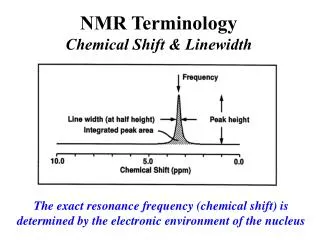
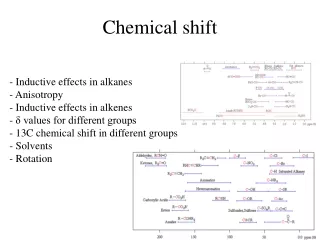
Chemical shift • Inductive effects in alkanes • Anisotropy • Inductive effects in alkenes • δ values for different groups • 13C chemical shift in different groups • Solvents • Rotation
δ-values: Hybridization effects δ values: sp3 < sp2 < sp Carbons with sp2 hybridization hold the electrons closer to the nucelus than do sp3 carbons. This leads to less shielding of the attached protons. Thus vinyl hydrogens have higher chemical shifts than alifatic hydrogens Acetylenic protons (sp-hybridized C) would be expected to have a higher chemical shift than vinyl protons. This is not true due to magnetic anistropy
Magnetic anisotropy A magnetic field with non-uniform density or non-sperical distribution The presence of π-electrons in a magnetic field sets up a small, local current and an anisotropic magnetic field in its close proximity Applies only to atoms with sp2 and sp hybridization
N-H and O-H chemical shift δ: very dependent on solvent and concentration R-O-H: 0,5 < δ < 4,5 R-N-H: 1,0 < δ < 5,0 Carboxylic acids (usually dimeric): 10 < δ 12 Enols: 12 < 18 In deuterated protic solvents: N-H, O-H and S-H can rapidly exchange D with solvent and the 1H-NMR signal disappears.
Solvents Non polar solvents: Small effect on chemical shift Polart + benzene : significant effect on chemical shift