
Echinoderms
E N D
Presentation Transcript
Echinoderms By Kyler, Jeffrey and Ayden
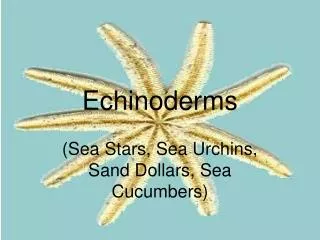
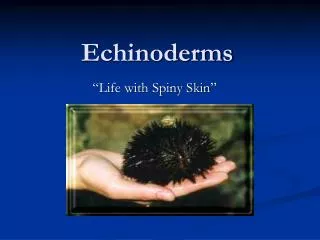
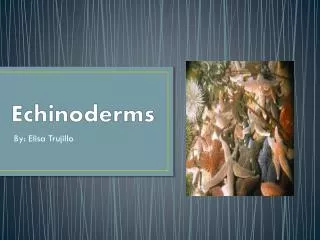
Description • a marine invertebrate of the phylum Echinodermata, such as a starfish, sea urchin, or sea cucumber.
Symmetry of Echinoderms • Evolved from bilateral symmetry • Larvae look like embryonic chordates • In adulthood, possess pentalateral symmetry (five sided)
Method of Feeding • Heterotrophs • Possess several methods • May be carnivorous or herbivorous
Circulation Open circulatory system Network of fluid filled canals Tube feet
Response • Cellular response and a humoral one. • Fixes problems
Excretion Uses its Water Vascular System to flush out any waste substances They have no organs for direct excretion
Movement • Have many tube feet on each of their “arms” • Expanding and contracting certain chambers in the water system • Moves water into certain feet which makes it move
Respiration • Exchanges carbon dioxide for oxygen • Tube is surface for respiration
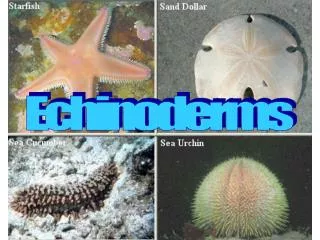
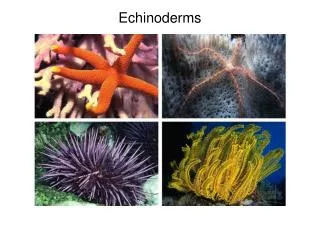
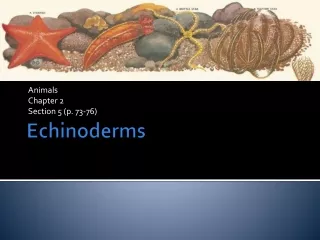
Classes and Examples • Divided into five extant classes https://www.shapeoflife.org/video/echinoderms-ultimate-animal • Asteroidea (starfish) • Ophiuroidea (brittle stars) • Echinoidea (sea urchin and sand dollars) • Crinoidea (sea lilies or feather stars) • Holothuroidea (sea cucumbers)