Cellular Respiration
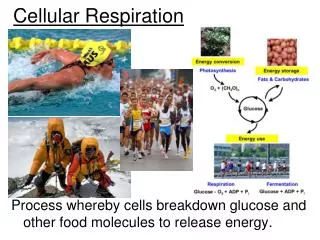
This comprehensive overview of cellular respiration outlines the key processes that convert glucose into energy within cells. It begins with photosynthesis, highlighting the importance of food as an energy source. The main stages of cellular respiration are detailed, including Glycolysis, the Krebs Cycle (Citric Acid Cycle), and the Electron Transport Chain. Each step's contributions to ATP production are explained, along with the role of high-energy electron carriers. Additionally, fermentation processes and the body's energy utilization during exercise are discussed, showcasing how cells adapt to oxygen availability.

Cellular Respiration
E N D
Presentation Transcript
Cellular Respiration Ms. Napolitano & Mrs. Haas CP Biology
Recall: • The photosynthesis equation is 6CO2 + 6H2O + light 6O2 + C6H12O6
Food • Food – source of raw material for the cells of the body • Energy source • calorie – amount of energy needed to raise 1 gram of water 1 degree Celsius • Calorie = kilocalorie = 1000 calories
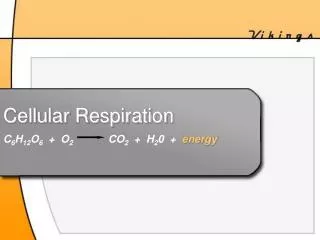
Cellular Respiration • Cellular respiration – the process that releases energy by breaking down glucose & other food molecules in the presence of oxygen • The equation for cellular respiration is: 6O2 + C6H12O6 6CO2 + 6H2O + Energy
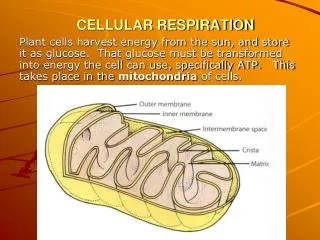
3 Parts of Cellular Respiration: • Glycolysis • Cytoplasm • Krebs cycle (AKA citric acid cycle) • Mitochondrial matrix • Electron transport chain • Inner mitochondrial matrix
PART I Glycolysis
Glycolysis • Glycolysis – process in which one molecule of glucose is broken in half • Produces 2 molecules of pyruvic acid = 3C compound • Anaerobic - does not require O2
ATP & NADPH Production • The cell needs to input some energy before more can be produced • 2 ATP used up, 4 ATP made = 2 ATP net gain • High-energy electrons are carried by NAD+ • Makes NADH • Similar to NADP+ in photosynthesis • Overall glycolysis equation: glucose 2 pyruvic acid + 2 ATP + 2 NADH
PART II The Krebs Cycle
The Krebs Cycle • Recall: 2 pyruvic acid molecules were made during glycolysis • Krebs cycle – pyruvic acid is broken down into CO2
Steps of the Krebs Cycle: • 1C from pyruvic acid becomes CO2 • Other 2C’s joined to a coenzyme to make acetyl-CoA • Acetyl group (2C) is converted to citric acid (4C) • 6C compound • Citric acid becomes 4C again • C’s become CO2 • ADP ATP • NAD+ NADH • FAD FADH2 High-energy electron carriers
Final Products of the Krebs Cycle: • 6 NADH • 2 FADH2 • 2 ATP • 2 CO2
PART III The Electron Transport Chain
The Electron Transport Chain • The electron transport chain – uses high-energy electrons from the Krebs cycle to convert ADP into ATP
Product: H2O • e- are passed from one protein to the next • Enzyme at the end combines e- with H+ and O2 to form H2O
Product: ATP • When 2e- pass through ETC, energy transports H+ across the membrane • ATP synthase pumps H+ to the other side of the membrane via facilitated diffusion • ATP synthase rotates like a turbine, making ADP + P ATP
Totals • Glycolysis = 2 ATP (net) • Krebs cycle + ETC = ~36 ATP • Total = ~38 ATP molecules from 1 glucose molecule!
Fermentation • Fermentation – process by which ATP is made in the absence of O2 • AKA anaerobic • Goes through glycolysis, then picks a different pathway • Alcoholic fermentation • Alcohol & CO2 is made as wastes • Made by yeast - causes bread to rise • Lactic acid fermentation • Lactic acid is made as a waste • Causes muscle soreness or helps make dairy products
Energy & Exercise • Quick energy • Only enough ATP in muscles for ~50m sprint (few seconds) • Lactic acid fermentation – ATP made for ~200-300m sprint (~90s) • Lactic acid removal requires extra O2 • Long-term energy • Cell respiration is the only way to make ATP for the long-term • Pace yourself! • Energy stored in muscles as glycogen • Stored glycogen - ~15-20 min of activity, then other energy forms get broken down (ex. fats – weight control!)