Download
1 / 2
20 likes | 135 Vues
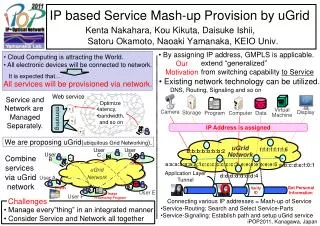
This paper presents a comprehensive framework for provisioning services via uGrid networking, integrating IP address assignment with advanced GMPLS techniques. By utilizing existing network technologies, we propose a solution that connects various electronic devices in a cloud computing environment, enabling optimal service routing, signaling, and management. The study includes the construction of a uGrid service-level topology that facilitates the integration of service and network resources, aimed at improving latency, bandwidth, and processing loads through efficient service-path computation and management.

E N D
IP based Service Mash-up Provision by uGridKenta Nakahara, Kou Kikuta, Daisuke Ishii,Satoru Okamoto, Naoaki Yamanaka, KEIO Univ. • By assigning IP address, GMPLS is applicable. • Cloud Computing is attracting the World. • All electronic devices will be connected to network. extend “generalized” from switching capability to Service Our Motivation It is expected that… • Existing network technology can be utilized. All services will be provisioned via network. DNS, Routing, Signaling and so on Web service Service and Network are Managed Separately. Optimize • latency, • bandwidth, • and so on mirroring Camera Computer XYZ Program Data Virtual Machine Display Storage IP Address is assigned We are proposing uGrid(ubiquitous Grid Networking). f:f:f:f:f:f:f:6 uGrid Network b:b:b:b:b:b:b:2 User D User C User B Combine services via uGrid network a:a:a:a:a:a:a:1 e:e:e:e:e:e:e:5 c:c:c:c:c:c:c:3 a:b:c:d:e:f:0:1 TV tuner uGrid Network Application Layer Tunnel d:d:d:d:d:d:d:4 User A Challenges XYZ Get Personal Information Display Verify ID User E 3D Image Processing Program User F • Connecting various IP addresses = Mash-up of Service • Service-Routing: Search and Select Service-Parts • Service-Signaling: Establish path and setup uGrid service • Manage every”thing” in an integrated manner • Consider Service and Network all together
Service-Routing Extended OSPF-TE for uGrid • Construct uGrid Service-Level topology • in link-state manner Service-Path Provision IP#x • Go through required service • in specified order • Consider the cost • Work with • Signaling IP#f IP#f IP#b IP#b Image Enhancement IP#c IP#c IP#e IP#e CPU Resource CPU Resource XYZ XYZ IP#g IP#g IP#a IP#a Face Detection IP#d IP#d IP#y Network-level Service-level Service provisioning with integrating both network resource and service resource Latency Bandwidth Power consumption Processing load Link-State info = • To confirm the effectiveness of Service-Routing, experiment is conducted. Experiment uGrid network Service-Path Computation Engine of Extended OSPF-TE 50.50.50.3 50.50.50.10 50.50.50.8 ② Node IDlook up by uGrid DB ① Service Request S F S F 50.50.50.2 50.50.50.5 C 50.50.50.2 ↓ 50.50.50.3 ↓ 50.50.50.3 or .8 ↓ 50.50.50.5 Camera ↓ Face Detection ↓ Sepia Conversion ↓ Display N N C D ③ Topology is transformed based on the request. S S 50.50.50.6 50.50.50.7 Service- Parts D (Sepia) Path and Reserve message Service- Parts B (Face Detection) Service- Parts C (Sepia) D Input ④ Ordinal Dijkstra is executed. Convert ⑤ Along the computed ERO, Service-Signaling is executed. Output ERO Result: Succeeded to provide image processing service by the shortest cost path Service-Parts A (Camera) Service-Parts G (Display) Service-Parts F Service-Parts E (Provide Network Connection Service) This work is supported by ”R&D for Construction of Leading-edge Green Cloud Infrastructure (Environment-Related Network Signaling Technology)” project of MIC of Japan.