Understanding the Endocrine System: Hormones and Regulation
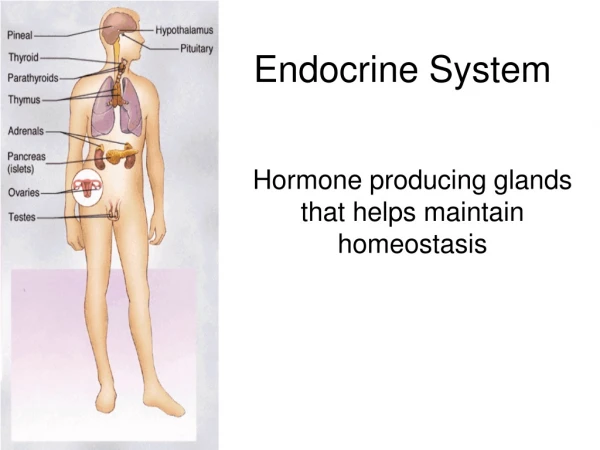
The endocrine system is vital for maintaining body homeostasis through hormonal signals. Hormones are chemicals produced in glands that regulate essential processes across different body organs. There are two main types of hormones: steroid hormones, which are lipid-based and diffuse into cells, and protein hormones, which are water-soluble and bind to cell membrane receptors. The pituitary gland, known as the master gland, plays a crucial role by controlling other endocrine glands and storing hormones produced by the hypothalamus. Understanding this system is essential for grasping how the body functions.

Understanding the Endocrine System: Hormones and Regulation
E N D
Presentation Transcript
Endocrine System The Importance of the Endocrine System
Introduction • The trillions of cells of the body all interact with each other—no cell operates in isolation. • Hormones are chemical regulators produced by cells in one part of the body that affect cells in another part of the body http://www.pituitarysociety.org/public/overview/normalpituitary?printablepage=1
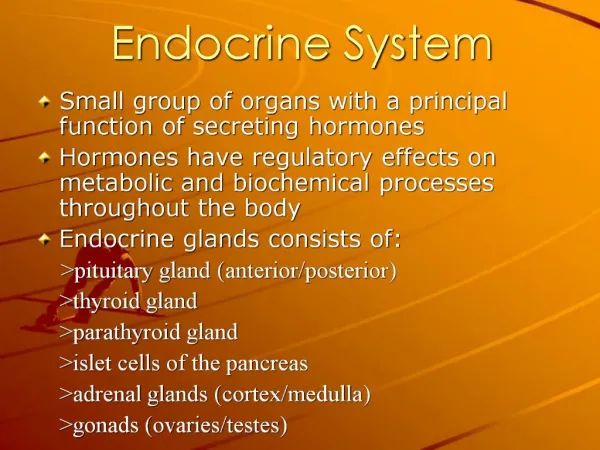
Endocrine hormones • Only small amounts of hormones are needed to affect the target organs • Endocrine hormones are chemicals produced in glands and secreted directly into the blood • The circulatory system carries these hormones to the various organs of the body.
Steroid and Protein Hormones • How do hormones signal cells? http://www.hcc.uce.ac.uk/physiology/endocrinesystem.htm
Steroid and Protein Hormones • Specific hormones do not affect all cells. • Cells may have receptors for one hormone but not another. • The number of receptors found on individual cells also may vary. • There are two types of hormones, which differ in chemical structure and action.
Steroid Hormones • Made from cholesterol (a lipid compound) • Includes male and female sex hormones and cortisol • Steroid molecules are composed of complex rings of carbon, hydrogen, and oxygen molecules and are not soluble in water but are soluble in fat. http://www.novatec-id.com/products/hormone-markers/steroid/
Steroid Hormones • Steroid hormones diffuse from the capillaries into the interstitial fluid and then into the target cells • they combine with receptor molecules located in the cytoplasm
Steroid Hormones • The hormone–receptor complex then moves into the nucleus and attaches to a specific site on the DNA • The hormone activates a gene • Ribosomes begin producing a specific protein http://163.16.28.248/bio/activelearner/47/ch47c1.html
Protein Hormones • Includes insulin and growth hormone • These hormones contain chains of amino acids of varying length and are soluble in water http://www.nibsc.ac.uk/science/diagnostics/protein_hormones__endocrine_p.aspx
Protein Hormones • Protein hormones combine with receptors on the cell membrane • Some of the protein hormones form a hormone– receptor complex that activates the production of an enzyme called adenylyl cyclase.
Adenyly Cyclase • The adenylyl cyclase causes the cell to convert ATP into cyclic AMP. • The cyclic AMP functions as a messenger, activating enzymes in the cytoplasm to carry out their normal functions • For example, when thyroid-stimulating hormone (TSH) attaches to the receptor sites in the thyroid gland, cyclic AMP is produced in thyroid cells. • The cyclic AMP in the thyroid cell activates enzymes, which begin producing thyroxine, a hormone that regulates metabolism.
The Pituitary Gland: the Master Gland • The pituitary gland exercises control over other endocrine glands. • This small sac-like structure is connected by a stalk to the hypothalamus, the area of the brain associated with homeostasis http://en.wikipedia.org/wiki/File:Pituitary_gland.png
http://bcs.whfreeman.com/thelifewire/content/chp42/4202s.swf
Pituitary Gland • The interaction between the nervous system and endocrine system is evident in this hypothalamus–pituitary complex • The pituitary gland produces and stores hormones • The hypothalamus stimulates the release of hormones by the pituitary gland by way of nerves.
Pituitary Gland • The pituitary gland is actually composed of two separate lobes: the posterior lobe and the anterior lobe • The posterior lobe of the pituitary stores and releases hormones such as antidiuretic hormone (ADH) and oxytocin, which have been produced by the hypothalamus http://www.neurosurgery.pitt.edu/minc/skullbase/pituitary/index.html
Pituitary Gland • The hormones travel by way of specialized nerve cells from the hypothalamus to the pituitary • The pituitary gland stores the hormones, releasing them into the blood when necessary
Pituitary Gland • The anterior lobe of the pituitary produces its own hormones • Like the posterior lobe, the anterior lobe is richly supplied with nerves from the hypothalamus • The hypothalamus regulates the release of hormones from the anterior pituitary http://ja.wikipedia.org/wiki/%E3%83%95%E3%82%A1%E3%82%A4%E3%83%AB:Pituitary_gland_et_vessel.jpg
Pituitary Gland • Most of the hormones produced by the hypothalamus activate specific cells in the pituitary, causing the release of pituitary hormones http://www.becomehealthynow.com/popups/pit_hypothalamus.htm
Hormones of the Pituitary • Various regulator hormones are stored in the anterior lobe of the pituitary gland. • Thyroid-stimulating hormone (TSH) • Reproductive stimulating hormones • Growth-stimulating hormones • Prolactin • Adrenocorticotropic hormone
http://kasper-achs-block3.wikispaces.com/General+Info+on+Glands+and+Hormoneshttp://kasper-achs-block3.wikispaces.com/General+Info+on+Glands+and+Hormones
Homework • Page 377 # 1 - 4