
Enhancing Pollinator Health and Livestock through the Upper Rogue Pollinator Project
E N D
Presentation Transcript
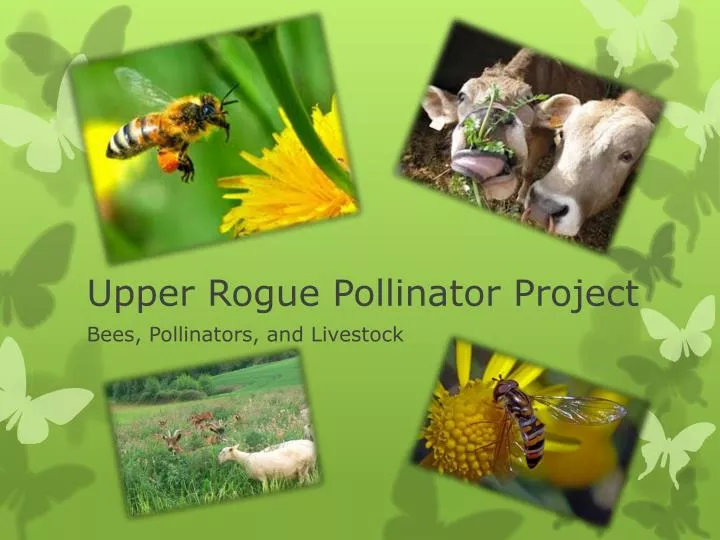
Upper Rogue Pollinator Project Bees, Pollinators, and Livestock
When beekeepers can’t keep their bees alive inside the box, how does a colony like this - against all odds - survive OUTSIDE the box? A Feral Colony Of Bees Could the reason be genetics?
The Value of Honey Bees(more than just honey) • More than just honey • Pollinate more than 90 of the tastiest flowering crops we have – among them: • Apples, nuts, avocados, soybeans, asparagus, broccoli, celery, squash and cucumbers • Citrus fruit, peaches, kiwi, cherries, blueberries, cranberries, strawberries, cantaloupe and other melons • One-third of the human diet comes from insect-pollinated plants. • The honeybee is responsible for 80 percent of that pollination. • Even CATTLE, which feed on alfalfa and clover, depend on bees
Demise of the Honey Bee?(Demise of Humanity?) • Colony Collapse Disorder (CCD) and pollinator decline • Main causes of colony collapse disorder are (according to most scientists): • Nutritional stress • Pathogens (mites, viruses and fungus) • Pesticides and insecticides (especially neonicotinoids) • Herbicides (destroy habitat) • Fungicides have insecticidal toxic affects on pollinators (killing off important bee "gut" microbiota) • Even adjuvants (so-called inert ingredients) in above chemicals
The Effects of Pollinator Decline • The success rate of beginning beekeepers is only 25%. • Even advanced beekeepers suffer between 30% - 65% hive loss. • Crops dependent on insect pollination are in decline (e.g., CA almonds).
Who are we?Wild Bee International • Teaching – Research – Development • Standardized teaching system for beginning beekeepers and youth. • Research stations to develop habitat and genetically superior bee stock while improving the sustainability of livestock production • Ultimate goal: An enhanced future for our children and grandchildren • Collaborate with OSU and SOBA.
A Solution – The Upper Rogue Pollinator Project • All pollinators in Jackson County are in peril. • Farmers’ and cattle owners’ lifestyles are in danger. • Local solution – enhanced genetics and improved habitat • Uniqueness of Southern Oregon
Upper Rogue Pollinator Project - The Concept • Collaboration among local farmers, cattle owners, beekeepers, scientists and researchers • Promote improved livestock foraging within a self-sustaining ecosystem • Focused on Upper Rogue River Basin • Controlled honeybee environment
Upper Rogue Pollinator Project - The Mission • Establish a controlled beekeeping environment to . . . • Breed a predominant, locally adapted and genetically advanced honeybee population while . . . • Increasing the forage basis for livestock. • Benefits Russian Queen Bee
Good For Bees - Good For Livestock:Sainfoins (Onobrychis) • Eurasian perennial herbs of the legume family • Extends throughout Europe as far north as southern Sweden • Grows on grassland, agricultural land and wasteland; non-invasive • Drought tolerant, winter-hardy and frost tolerant • Blooms between June and September and pollinated by honey bees and solitary bees • Superb forage for grazing animals - voluntary intake of sainfoin by cattle and sheep is 20% higher than for grass • Non-bloating, anthelmintic (extremely palatable & nutritious), increased protein absorption, very rapid liveweight gains • Excellent source of nectar for honey production as well as pollen for bee food U.R.P.P.
History and Variety Development of Sainfoins in America • Introduced into the Northern Great Plains in the 1800s. • Variety Development Certified seed is available from seed producers in Wyoming, Montana.
U.R.P.P. Target Area:Rogue Basin Watershed - Little Butte Basin
U.R.P.P. Goal: Distribution to local beekeepers – over time – will establish a predominant, genetically advanced honeybee.
Upper Rogue Pollinator ProjectEndorsed by: • Ramesh Sagili – OSU Professor, Dept of Horticulture & Honey Bee Lab • Randy White - Jackson County Soil and Water Conservation District Manager • Paul Showalter - Natural Resources Conservation Service (USDA) conservationist • Greg Grissom - President of Lake Creek Historical Society • Hugh Charley - President of the Stockmens Association • Ralph McKechnie - Owner of the Upper Rogue Independant • Ron Padgett – President of the Southern Oregon Beekeepers Association (SOBA)