pH , Acids and Bases
This text covers essential concepts of pH, acids, and bases, explaining how substances dissociate in water and their implications in biological systems. It outlines the pH scale, detailing the properties of acids and bases, their ion concentrations, and their roles in reactions. Key points include the measurement of acidity and basicity, the importance of buffers in maintaining pH stability in cells, and how pH influences molecular shape and function. Understanding these fundamentals is crucial for exploring cellular processes and chemical interactions in biology.

pH , Acids and Bases
E N D
Presentation Transcript
pH , Acids and Bases Pg 164-165
pH • Reminder: Water is held together by ___________________ bonds. • These are relatively __________ bonds. • These bonds are constantly _________ and _____________. • Water molecules can naturally break apart. This is called the dissociation of water.
Acids, Bases and pH One water molecule in 550 million naturally dissociates into a Hydrogen Ion (H+) and a Hydroxide Ion (OH-) Hydrogen Ion Hydroxide Ion Acid Base H2O H+ + OH-
The pH Scale **Some compounds form acids or bases Scientists use something called the pH scale to measure how acidic or basic a liquid is The scale looks at the concentration of positively charged hydrogen ions (H+) in a solution vs. the amount of negatively charged hydroxide ions (OH-) The scale goes from values 0 through 14. Brain pop
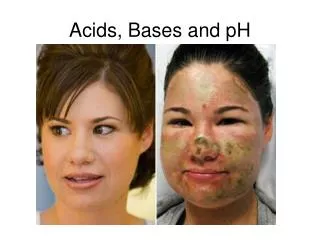
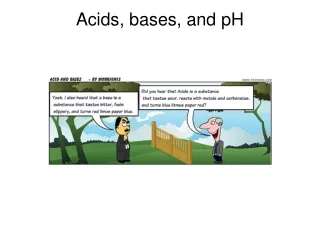
Acids • An acid releases hydrogen ions when it dissolves in water. • HighH+concentration • Low OH- concentration • - pH less than 7 • Tastes sour • Corrodes metals
Bases • Tastes bitter, chalky • Feels soapy, slippery A base releases hydroxide ions
A B Left to right
Summary! • If you have an ionic compound and you put it in water, it will break apart into two ions. • If one of those ions is H+, the solution is acidic. • If one of the ions is OH-, the solution is basic. There are other ions that make acidic and basic solutions, but we won't be talking about them here.
Neutral • Pure water contains small, but equal amounts of ions: H+ and OH- • On the pH scale the number is 7
Acids vs Bases • Acids: Anything that dissolves in water and adds H+. • Bases: Anything that dissolves in water and adds OH- ions.
Buffers • Buffer - mixtures that can react with acids or bases to prevent major pH changes. • Buffered aspirin has a coating on it to prevent the acids in your stomach from dissolving it right away.
9 8 7 6 Buffering range 5 pH 4 3 2 1 0 0 1 2 3 4 5 Amount of base added Buffers & Cellular Regulation • pH of cells must be kept ~7 • pH affects the shapeof molecules • shape of molecules affects function • pH affects cellular function • Buffers Control pH • donate H+ when [H+] falls • absorb H+ when [H+] rises Honors Biology