Mastering Polynomial Factorization: Quadratics Simplified
Learn how to effectively factor polynomials and solve quadratic equations using various methods. This guide covers multiplying to find factors, employing T-tables for simplification, graphing quadratic functions, and using the quadratic formula. It includes step-by-step examples to make the concepts clear and easily understandable. Whether you are preparing for exams or enhancing your math skills, this resource offers essential techniques to tackle quadratic functions confidently.

Mastering Polynomial Factorization: Quadratics Simplified
E N D
Presentation Transcript
QUADRATICS JOURNAL Amani Mubarak 9-5
How to factor polynomials 1.First multiply aXc. 2.Now find two factors of that multiply to the answer of aXc, and that will also Add up to b. *USE A T-TABLE TO MAKE IT EASIER. (In one side of t-table you write b and in the other side the answer of aXc.) Ex.1 2X²-8X+6 12 8 1. 2X6=12 -2 X -6 2 2 -2 + -6 X= -1, -3
Ex.2 Ex.4 x² + 8x = -15 +15 +15 X²+8x+15= 0 15 8 3X5 3+5 x x= 3,5 3x²-2x-16= 0 -48 -2 -8X6 -8+6 3 3 X= 8/3, -2 Ex.3 x² +7x+15= 5 10 7 -5 2x5 2+5 x² + 7x + 15= 0 x x= 2,5
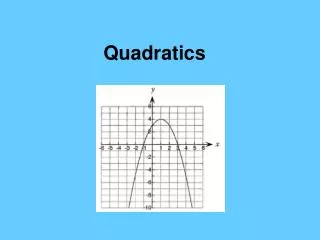
QUADRATIC FUNCTION • A QuadraticFunctioniswritten in theform: f(x) = ax2 + bx + c. • The graph of a quadratic function is a curve called a parabola. LINEAR FUNCTION • A Linear Functioniswritten in theform:y= mx+ b • The graph of a linear function is a straight line.
Itsvery simple totellthedifferencebetweenthistwotypes of functions, since a graph of a quadraticfunctionwillhave a curved line, parabola, and a linear functionisjust a straight line. Ex.1 Ex.2 y= 1/2x + 2 y=3x² + 6x + 1
Ex. 4 Ex. 3 y= -x + 5 y= 1/2x² +0 + 0
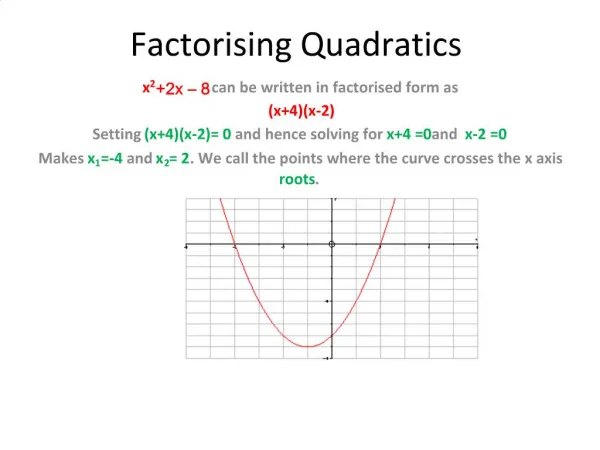
HOW TO GRAPH A QUADRATIC FUNCTION • f (x) = ax2 + bx + c • Y intercept of the graph is found by f(0)=c • X intercept of the graph is found by solving the equation: ax2 + bx + c = 0 • ax2 + bx + c = 0 is solved by using –b/2a • STEPS: 1. set = 0 2. graphthefunction a. make a t-table b. findthevertex x= -b÷2ª c. pick 2 pointstotheleft and 2 totheright. d. graphthe parable 3. find x-valueswhereitcrossesthe x-axis.
Examples: • y= -x² + 0 + 0 -b/2ª= 0 x y 0 0 1 -1 2 -4 3 -9 X=0,0
2. y= 1/2x² +0 + 0 -b/2(a)=0 x y 0 0 1 0.5 2 2 3 4.5 X=0,0
3. y=3x² + 6x + 1 -b/2(a)= -6/2(3) -6/6= -1 X Y -1 -2 0 1 1 10 2 19 X= -1,-2
4. y= x² + 2x + 5 -b/2(a)= -2/2(0)= -2/2 x y -2 -3 -1 -2 0 -1 1 0
Howtosolve a quadraticequation by graphingit • a (x + b)² + c= 0 a- changesthestepnessoftheline. b- moves rightotleft. Left= + Positive= - c- moves thevertexupordown. (Positive goesup. Negativegoesdown.) * If a is lessthan 0 if a isbiggerthan 0
Examples: • Y= -2 (x-4)²+5 Y= 2(x+3) 2-2
Y=4/2 (x-2) -6 Y=2/4(x+3) -3
Howtosolvequadraticequationusingsquareroots • X²=k • Ifyourequation has a # nextto x: • 1. Youhaveto divide bothsides by that # toisolate x². • Thenyousimplify. • Use thesquarerootpropertytoobtainto posible answers.
Examples: • K²=16 √ 16 k= 4, -4 2. K²=21 √ 21 k= 7,-7 3. 4n²= 20 4 N²=5,-5 7x² = -21 7 x²= 3, -3
Howtosolvequadraticequationusingfactoring: • In ordertofactor a quadraticyoumustfindcommonnumbersthatwillmultiply b and add up to c. Thenputeach set = 0. Ex.1 Ex.2 x2 + 5x + 6 = (x + 2)(x + 3) (x + 2)(x + 3) = 0 x+ 2 = 0 or x + 3 = 0 x = –2 or x = – 3 x= –3, –2 x2 – 2x – 3 = 0 (x – 3)(x + 1) = 0 x – 3 = 0 or x + 1 = 0 x = 3 or x = –1 x= –1, 3
Ex.3 x2 + 5x – 6 = 0 (x + 6)(x – 1) = 0 x + 6 = 0 or x – 1 = 0 x = –6 or x = 1 x= –6, 1 Ex.4 . x2+5x+6=0. (x+2)(x+3)=0. x=-2 and x=-3.
Completingthesquare • To complete thesquare: • Get a=1 • Find b, divide b/2, squareit (b/2)² • Factor (x+b/2)² Ex. X² + 14x + 49 x²+26x+169
Howtosolvequadraticequationsusingcompletingthesquare: • STEPS: 1. get x²=1 2. get c by itself 3. complethesquare 4. add b/2² tobothsides 5. squarerootbothsides
Examples: 3.X² + 16p – 22= 0 +22 +22 • X² + 16x= 22 +1 • x+1= ± 4.8 • X= 5.8, 3.8 • 4. X² + 8k + 12 = 0 • -12 -12 • X² + 8x = 13 • X+1= ±3.6 • X= 4.6, 2.6 • A² + 2 a – 3= 0 +3 +3 A²+ 2 a= 3 +1 √(a+1)² = √4 A + 1= ± 2 A= 3,1 2. A² - 2a – 8= 0 +8 +8 A²- 2a= 8 +1 √(a-1)² = √9 A-1= ± 3 A= 4,2 √(x + 1)² = √23 √(x+1)² = √13
Howtosolvequadraticequationsusingquadratic formula: • X= -b ± √b²-4ac 2 a 1. Find a, b, c and fillthem in. Ex.2 Ex.1 3x² -4x -9= 0 A= 3 b= -4= c=9 4± √16+108= 4±√124 6 6 2±√31 3 M²- 5m-14=0 A= 1 b=-5 c= -14 5 ± √ 25 + 56 = 5±√81 2 2 5±√9 2
Ex.3 C²- 4c + 4= 0 4± √16-16 = 4± √0 -8 -8 2±√0 -4 Ex.4 3±√9+40 = 3±√49 4 4 3±√7 4