Innovative Brain Tumor Segmentation Using Pseudo-Conditional Random Fields for Improved Accuracy
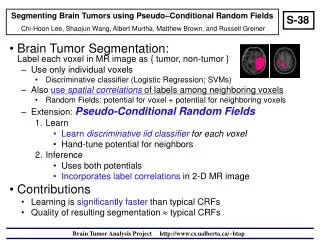
This project focuses on advanced brain tumor segmentation in MR images by labeling each voxel as either tumor or non-tumor. Utilizing discriminative classifiers like Logistic Regression and SVMs, along with spatial correlations from neighboring voxels, the method leverages Random Fields and Pseudo-Conditional Random Fields to enhance learning and classification speed. The approach incorporates correlations in a 2-D MR image, resulting in segmentation quality comparable to traditional Conditional Random Fields (CRFs) but with significantly reduced learning time.

Innovative Brain Tumor Segmentation Using Pseudo-Conditional Random Fields for Improved Accuracy
E N D
Presentation Transcript
Brain Tumor Segmentation:Label each voxel in MR image as { tumor, non-tumor } Use only individual voxels Discriminative classifier (Logistic Regression; SVMs) Also use spatial correlations of labels among neighboring voxels Random Fields: potential for voxel + potential for neighboring voxels Extension: Pseudo-Conditional Random Fields Learn Learn discriminative iid classifier for each voxel Hand-tune potential for neighbors Inference Uses both potentials Incorporates label correlations in 2-D MR image Contributions Learning is significantly faster than typical CRFs Quality of resulting segmentation typical CRFs Segmenting Brain Tumors using Pseudo–Conditional Random Fields Chi-Hoon Lee, Shaojun Wang, Albert Murtha, Matthew Brown, and Russell Greiner S-38 Brain Tumor Analysis Projecthttp://www.cs.ualberta.ca/~btap