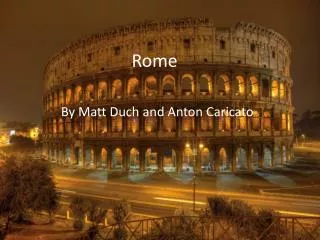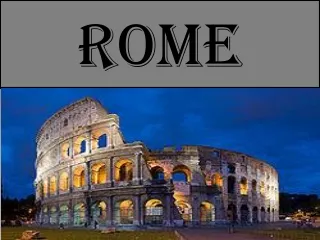
ROME
Explore the complex legacy of Roman civilization, which brought both enlightenment and tyranny to ancient societies. Rome's achievements in unifying diverse populations under a common legal system and language contrast starkly with its military aggressions. While it advanced infrastructure, social homogeneity, and preserved Greek knowledge, it also imposed brutal dominance, leading to the extermination and enslavement of countless peoples. This analysis delves into the duality of Roman contributions and costs, highlighting crucial historical periods, governance, and the socio-cultural dynamics of the Roman Empire.

ROME
E N D
Presentation Transcript
1. Civilization A • Brought the light of civilized existence to tribal societies. • Assimilated the contributions of superior cultures. • Unified vast territories and different peoples under one rule (through a common legal system, bureaucracy and language).
2. Civilization B • Brought other populations under their control through military aggression. • Exterminated foreign populations through war. • Enslaved foreign peoples: force labor, deportation. • Seized and occupied foreign lands with settlers. • Violently repressed uprisings of native populations • Supported repressive foreign regimes in exchange for adherence from the ruling classes. • Treated leniently non-confrontational civilizations: self-rule in exchange for taxes or military support
3. Roman civilization • Barbaric peoples, tribes • Superior civilization • Freedom, liberation • Expansion, unification, pacification, civilization
3. Roman civilization • The Roman empire was the largest and most perdurable of the western world in Ancient times. • It lasted around 700 years.
3. Roman civilization Consequences of the unification of the Mediterranean under Roman rule: • Common body of Law • Roman technical advances created new infrastructure • Improvement in communications • A more homogeneous society • Latin as a common language • Preserved, added to and transmitted the Greek body of knowledge (literature, architecture, philosophy, science…) .
3. Roman civilization • Human cost of domination • 1,000,000 Gauls exterminated by Caesar. • Some German and Gallic tribes disappeared and with them their way of life. • Large portions of foreign populations enslaved and savagely repressed when they revolted: Spartacus and 6,000 followers crucified, Carthage destroyed.
4. Historical outline Three main periods: • Roman Monarchy (753 to 509 BCE) • Roman Republic (509 to 31 BCE) • Roman Empire (31 BCE to 248 AD)
5. Roman monarchy: Etruscans Roman Monarchy (753 BCE to 509 BCE) Etruscan influence in Rome
5. Roman monarchy: Etruscans Etruscan art
5. Roman Monarchy Features of the Roman Monarchy: (753 BCE to 509 BCE) • Rome is dominated by the Etruscans • Rural society (shepherds) • City states • Myths: Aeneas, Romulus and Remus, Sabine women.
6. Roman Republic Roman Republic (509 BCE to 31 BCE) • Government: • Two consuls • Senate • Assembly • Magistracies (public administrators) • Restricted democracy: indirect representation
6. Roman Republic • Social conflicts: • Patricians (aristocracy, ruling class) and plebeians (disenfranchised middle class) • Aristocrats (ruling families) and the equestrian class (soldiers enriched by foreign wars)
6. Roman Republic • Military campaigns: • Conquest of Italy (Etruscans, Greeks, Italic peoples) • Punic Wars (264-146 BCE) against the Carthaginians. • Conquest of the East: Hellenistic kingdoms (146 BCE) • Conquest of the West: Gaul (60-44 BCE).
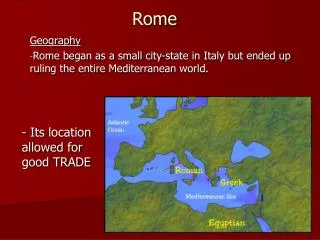
6. Roman Republic: Expansion The Mediterranean before Roman expansion
6. Roman Republic: Punic Wars. • Punic wars: • Carthage is the capital of the Carthaginians (Poeni) • Hannibal: Carthaginian general • Scipio: Roman general • Consequence of the war: Rome conquers the Western Mediterranean (Sicily, Spain, Northern Africa).
6. Roman Republic: Hellenistic kingdoms Conquest of the Hellenistic kingdoms (146 BCE-31 BCE): Macedonia, Greece, Asia Minor (Pergamum), Syria, Egypt (Cleopatra)…
6. Roman Republic: Gaul Conquest of the Gaul by Julius Caesar (60-44 BCE).
7. Roman Empire • Government: emperor • Octavian (Augustus) 31-14 BCE: Pax Romana • Absolute power of the emperor • Consolidation of Roman power and administration in all the provinces
7. Roman Empire Maximum expansion of the Roman empire (116 AD)
8. Topics • Army and empire • Opulence and decadence • Cruelty and spectacle • Daily life in Pompeii
9. Opulence and decadence • Frugalitas(austerity) • Mosmaiorum(customs of the ancestors) • Moral decline is associated with wealth and foreign influence • Problematic relationship with Greek art and literature (extravagant)
9. Opulence and decadence • Reasons for the “myth”: • Wealthy aristocrats: art collectors, owners of magnificent villas … • Banquet: means of political networking • Roman invective (political attacks): accusations of decadence.
11. Daily life: the house The Roman House • Vestibule: images of ancestors • Atrium: entrance courtyard • Tablinum: office • Peristyle: backyard/ garden
11. Daily life: the house • Walls decorated with frescoes • Floor covered with mosaics • Scarce furniture
11. Daily Life: the house Tablinum (dining room) Peristylum
11. Daily life: Baths • Baths: • Daily ritual • Cultural and sports complex: library, lectures, gyms, swimming pool, sauna, gardens, (and of course prostitutes, food, board games…) • Hygiene: daily bath
11. Daily life: Baths Caldarium (hot sauna) Natatio (swimming pool)
11. Daily life: Baths Piscina mirabilis (cistern) Aqueducts
11. Daily life Playing dice Tavern