SlideServe
Menu
Préférences
© SlideServe · v2026

Possible high-density H-storage system? A model problem : Ca + -4 H 2

twila avatar
2 diapositives · 186 Views · Sep 23, 2014

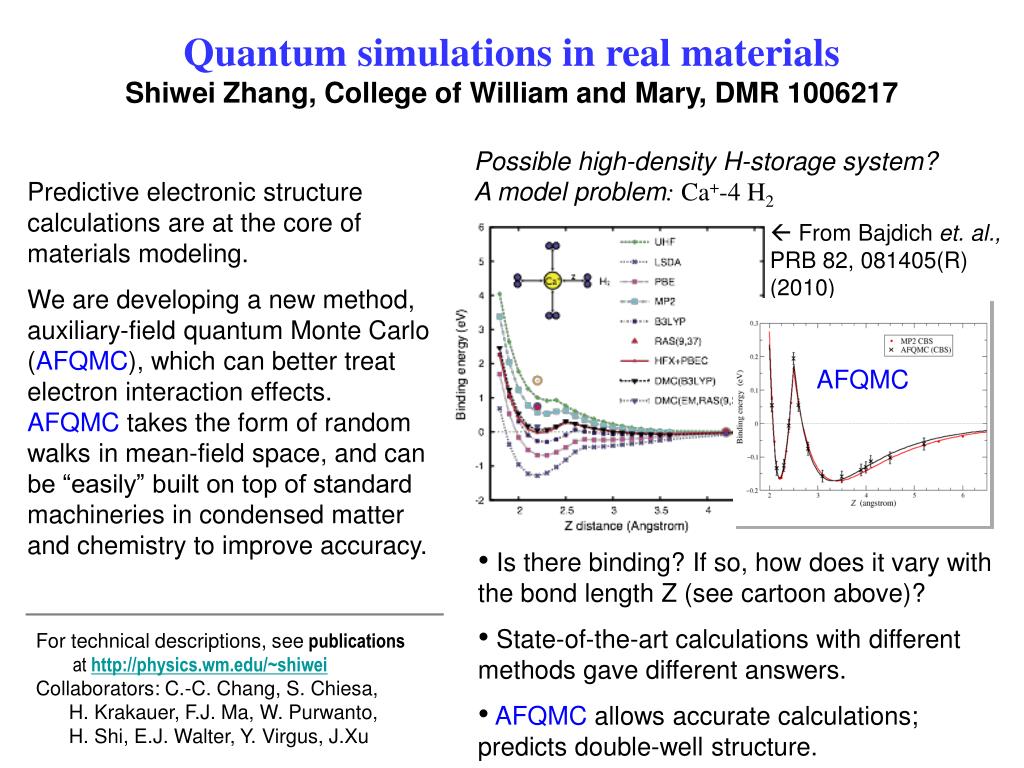
Quantum simulations in real materials Shiwei Zhang, College of William and Mary, DMR 1006217. Possible high-density H-storage system? A model problem : Ca + -4 H 2. Predictive electronic structure calculations are at the core of materials modeling.
Possible high-density H-storage system? A model problem : Ca + -4 H 2 - slide 1
01 / 2Possible high-density H-storage system? A model problem : Ca + -4 H 2
1 / 17

Télécharger la présentation

Possible high-density H-storage system? A model problem : Ca + -4 H 2
Une image / un lien ci-dessous est fourni (tel quel) pour télécharger la présentation

Politique de téléchargement : le contenu du site vous est fourni TEL QUEL pour votre information et votre usage personnel ; il ne peut être vendu, concédé sous licence ni partagé sur d’autres sites sans l’accord de son auteur.Le contenu vous est fourni TEL QUEL, pour votre information et votre usage personnel uniquement. Téléchargez la présentation en cliquant sur ce lien. Lors du téléchargement, si vous ne parvenez pas à télécharger une présentation, l’éditeur a peut-être supprimé le fichier de son serveur.Pendant le téléchargement, si vous ne parvenez pas à obtenir une présentation, le fichier a peut-être été supprimé par l’éditeur.

F I N

Plus de contenu associé

Transcription de la présentation
  1. Quantum simulations in real materialsShiweiZhang, College of William and Mary, DMR 1006217 Possible high-density H-storage system? A model problem: Ca+-4 H2 Predictive electronic structure calculations are at the core of materials modeling. We are developing a new method, auxiliary-field quantum Monte Carlo (AFQMC), which can better treat electron interaction effects. AFQMC takes the form of random walks in mean-field space, and can be “easily” built on top of standard machineries in condensed matter and chemistry to improve accuracy.  From Bajdichet. al., PRB 82, 081405(R) (2010) AFQMC • Is there binding? If so, how does it vary with the bond length Z (see cartoon above)? For technical descriptions, see publications athttp://physics.wm.edu/~shiwei Collaborators: C.-C. Chang, S. Chiesa, H. Krakauer, F.J. Ma, W. Purwanto, H. Shi, E.J. Walter, Y. Virgus, J.Xu • State-of-the-art calculations with different methods gave different answers. • AFQMCallows accurate calculations; predicts double-well structure.

  2. Quantum simulations in real materialsShiwei Zhang, College of William and Mary, DMR 1006217 • Curriculum development: course on Computer Simulations in Physics • Undergraduate year-long research and REU • - Recent Ph.D students and postdocs: Wissam Al-Saidi(now U. Pitt.); Chia-Chen Chang (now UC Davis); Simone Chiesa; Fengjie Ma; HendraKwee(Now professor in Indonesia);WirawanPurwanto; H. Shi; M. Cherry Suewattana(Now faculty at MahidolUniv); Dorothy J. Xu • Co-organizer and/or lecturer of several summer/winter schools “Matter show” – W&M Physics faculty members developed a highly popular set of demos to illustrate the state of matter, using liquid helium. The PI doing a “matter show” at a local elementary school. http://physics.wm.edu/~shiwei