Download
1 / 14
140 likes | 256 Vues
This lesson explores the concept of solutions in algebra, demonstrating how two different equations can yield the same solution. By applying properties of equality, students will learn to analyze equations containing unknown values. We will discuss examples such as how x + 7 = 14 aligns with x - 3 = 4, and determine if various pairs of algebraic expressions share the same solution. This lesson aims to deepen your understanding of equality in mathematics and the definition of solutions through practical exercises and examples.

E N D
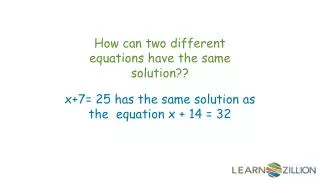
How can two different equations have the same solution?? x+7= 25 has the same solution as the equation x + 14 = 32
In this lesson you will learn that properties of equality apply to equations containing unknown valuesby making connections to real numbers
9 = 9 9 – 6 = 9– 6 3 = 3
5 = 5 5 + 7 = 5 + 7 12 = 12
What does “solution” mean in math? x-2=0 2 is a solution
Forgetting properties of equality apply to algebraic expressions
x+5 = 10 and x+15 = 20 x+5 + 10= 10 + 10 x+15 = 20
x + 7 = 14 and x – 2 = 5 x + 7 - 9= 14- 9 x – 2 = 5
In this lesson you have learned how to tell if equations have the same solutionby using the principles of equality
Do the pairs of algebraic expressions have the same solution? x = 7 and x + 8 = 15 x + 4 = 6 and x + 2 = 8
How would you know that two expressions do not have the same solution? Show your work and provide an example
Using the mathematical definition of solution, what is the solution for x + 2 = 5? Is it the same solution as x + 6 = 9? Show your work.
Describe the steps you would take to determine if X + 7 =14 and x -3= 4 have the same solution. Complete the problem and show yourwork.
Do x + 7 = 4 and x + 10 = 7 have the same solution? Do x + 9 = 20 and x + 1 = 12 have the same solution?