Download
1 / 15
160 likes | 291 Vues
This overview compares prokaryotic and eukaryotic cells, highlighting their differences and organelles. Prokaryotes lack a nucleus, with hereditary information located in the cytoplasm, and include bacteria. In contrast, eukaryotes, like plants and animals, have a defined nucleus and evolved from prokaryotic cells. Key organelles such as the nucleus, mitochondria, chloroplasts, and Golgi apparatus perform essential functions. Understanding these structures and their roles is crucial for grasping cellular biology.

E N D
Organelles Prokaryotes vs. Eukaryotes
Prokaryotes • Cells have no nucleus • Information for heredity is contained within the cytoplasm. • First cells to evolve • Ex: Bacteria
Eukaryotes • Have nucleus • Information for heredity is contained within the nucleus • Cells evolve from prokaryotes • EX: Animals, protists, fungi, & plants
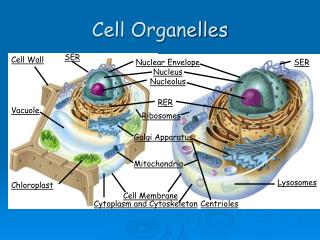
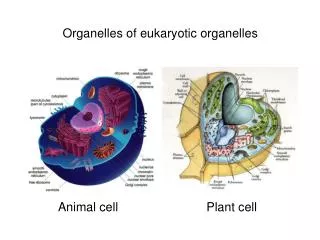
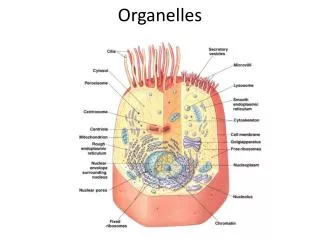
Organelles • Tiny membrane-bound structures that perform special functions inside the cell.
Cell Wall • Only found in plants, fungi, & bacterial cells • Strong, rigid, & stiff. • Provides support & protection for the cell.
Cell Membrane • Membrane that protects and supports the cell. • Allows movement of nutrients in and out of the cell. • Included in ALL cells.
Nucleus • Found in both plant and animal cells. • Large, oval shape • Centrally located (center) • Controls the activities of the cell.
Cytoplasm • Both plant and animal cells. • Clear, thick, jelly-like substance • Supports and protects the organelles.
Golgi apparatus • Plant and animal cells • Looks like flattened stack of pancakes • Packages proteins made by the cell
Ribosomes • Plant and animal cells • Can be attached to the endoplasmic rectiulum (ER) or free floating • Produces proteins
Endoplasmic reticulum • Plants and animal cells • Network of tubes • Transports materials throughout the cell. • Rough & smooth (types)
mitochondria • Plant and animal cells • Looks like a jellybean • Breaks down sugars to release useable energy.
vacuoles • Plant and animal cells • Fluid filled sacs • Store food, water, & waste
lysosomes • Only in animal cells • Small & Round • Breaks down large food molecules into smaller ones. • Digests old cell parts
chloroplasts • Plant cells ONLY • Oval • Green from cholorophyll • Uses energy from the sun to make food