Understanding Energy: Types, Forms, and Applications
50 likes | 182 Vues
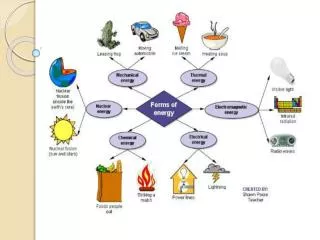
Energy is the ability to do work, defined as the product of force and distance. It exists in two major forms: kinetic energy, derived from motion (KE = ½mv²), and potential energy, derived from position (PE). Potential energy can take various forms, including gravitational potential energy (PEgravity = weight x height = mgh), elastic potential energy, and chemical energy. Additionally, thermal energy, a type of kinetic energy, relates to an object's temperature, where hotter objects have faster-moving particles. Energy can be stored, transformed, and transferred in various ways.


Understanding Energy: Types, Forms, and Applications
E N D
Presentation Transcript
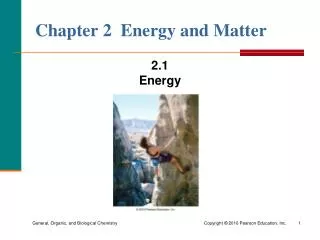
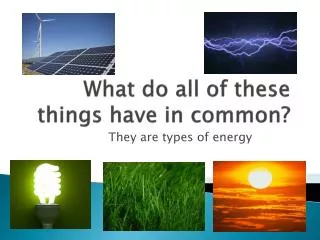
Energy Is the ability to do work where work =Force x (parallel) distance Is the ability to cause change Can be stored, transformed andtransferred
two major forms of energy • energy of motion; the energy an object has as a result of the amount of mass and its speed: • Kinetic Energy = ½ mv2 • energy of position; the energy an object has as a result of its location: • Potential Energy = various forms and formulas • PEgravity = weight x height = mgh = magravityh • Others include ‘elastic’ PE as in springs and chemical energy
Heat? Thermal Energy is the energy due to the temperature of an object; this is actually Kinetic Energy. Hotter objects are made up of particles that are moving more quickly than colder objects. Heat is the energy that flows from hot objects to cold objects