Discovering Gold: Properties, Uses, and History of Au
Gold (Au), with atomic number 79 and an atomic weight of 196.97, is a fascinating metal known for its density of 19.282 g/cm³ and a melting point of 1337 K. Discovered in 1848 by James William Marshall, gold is essential in electronics due to its inertness and unique physical properties. It serves multiple purposes including electrical contacts, jewelry, and historical health practices. Additionally, its reflective qualities make it useful for coating satellites. Explore the rich history and diverse applications of this precious metal.

Discovering Gold: Properties, Uses, and History of Au
E N D
Presentation Transcript
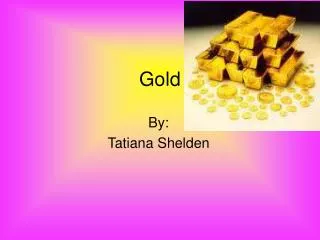
Gold By: Tatiana Shelden
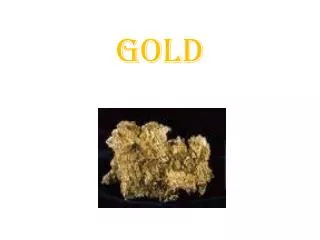
Information on Gold • Atomic name:Au • Atomic Number:79 • Atomic Weight:196.966569 • Melting point:1337 K (2856 C or 5173 F) • Phase at room temperature:Solid • Element classification:Metal
More Information on Gold • Density:19.282 grams per cubic centimeter • Period Number:6 • Group Number:11 • Group Name:No group name
Who &When Was it Discovered • James William Marshall was the person who discovered the gold atom in the year of 1848.
Uses for Gold • Gold is a really useful metal for electronics because of its inertness and physical properties. • Gold is used for electrical contacts,spring contacts,bonding wires, solder alloys,bumping wires, electro planting,and sputtering targets. Gold is also useful brazing material.Gold is used for coating space satellites, as it is a good IR reflector and is inert.
What is in an Atom • 79 protons • 79 electrons • 3 neutrons
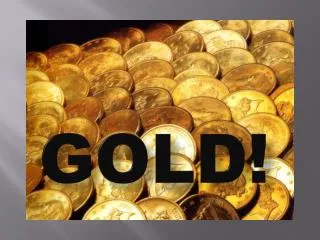
Another use for Gold • One use for gold is as to be worn as jewelry • Another use is for wealth and health. • In the ancient times gold was used for health and Egypt used the gold for their Kings or their leader the people of Egypt burry their kings with gold and money
Was There such Thing as Gold dogs? • Yes there is gold dogs called golden retrievers.
Bibliography • http://periodic.lanl.gov/elements/79.html • http://education.jlab.org/itselemental/ele079.html • http://environmentalchemistry.com/yogi/periodic/Au.html