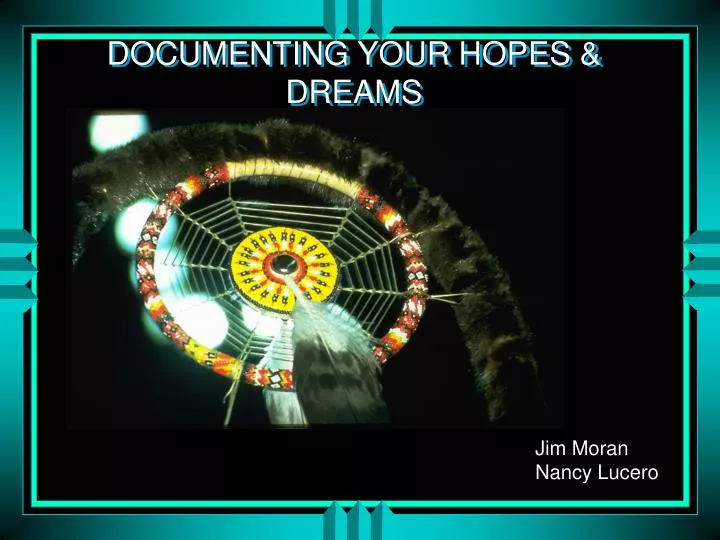
DOCUMENTING YOUR HOPES & DREAMS
170 likes | 255 Vues
DOCUMENTING YOUR HOPES & DREAMS. Jim Moran Nancy Lucero. A PROGRAM IS A STORY. Lessons are learned through the telling Everything in the story is of value and has something to teach us Evaluation helps us capture the story and improve our programs.


DOCUMENTING YOUR HOPES & DREAMS
E N D
Presentation Transcript
DOCUMENTING YOUR HOPES & DREAMS Jim Moran Nancy Lucero
A PROGRAM IS A STORY • Lessons are learned through the telling • Everything in the story is of value and has something to teach us • Evaluation helps us capture the story and improve our programs
GUIDING PRINCIPLES OF THEINDIGENOUS EVALUATION FRAMEWORK • Indians have always had ways of assessing merit or worth • This knowledge should inform how evaluation is conducted in our communities • An Indigenous framework can incorporate broadly held values while also remaining flexible and responsive to local traditions and cultures
THE WOKSAPE OYATE STORY Developing INTELLECTUAL CAPITAL at TCUs BY: • Delivering a high quality education • Training the next generation of leaders • Providing a challenging learning environment • Generating Excellence Across your Institution Through Investing in: • Academic Programs • Professional Development • Recruitment & Retention
TELLING THE WOKSAPE OYATE STORY INPUTS ACTIVITIES & OUTPUTS Assumptions Assumptions Institutional Impact through increasing INTELLECTUAL CAPITAL OUTCOMES Assumptions
TELLING THE WOKSAPE OYATE STORY ACTIVITIES & OUTPUTS Assumptions Assumptions Institutional Impact through increasing INTELLECTUAL CAPITAL OUTCOMES Assumptions
Outputs vs. Outcomes Output Direct Product of the Activities – Volume of Work Accomplished Outcome Changes Resulting from Activities & Outputs
OUTPUTS Products of a program’s activities - data about the volume of work • number of participants • number and type of classes • establish a tutoring center • set up advisory board • changes in a curriculum
OUTCOMES Specific changes in behaviors, knowledge, skills, level of functioning • increase in cultural identity • fluency in tribal language • improvement in math scores • % increase in graduation rates • new academic program established
THE WOKSAPE OYATE EVALUATION PROCESS Step 1: Brainstorm Intended Outcomes Step 2: List Program Activities Step 3: Identify Outputs For each Activity Step 4: OutputsOutcomes Step 5: Measuring Outcomes Step 6: Describing the Impacts on Intellectual Capital and Institutional Capacity
STEP 1: Brainstorm Intended Outcomes Within each area • Academic Programs • Professional Development • Recruitment & Retention What changes will happen that you believe are linked to your program? Explain how each outcome is related to increasing Intellectual Capital (What are your Assumptions)
Step 2: List Program Activities Within each area • Academic Programs • Professional Development • Recruitment & Retention List all services provided (things done in course of carrying out the program) How is each activity related to the Outcomes? Why do you believe this?
Step 3: Identify Outputs For each Activity Within each area • Academic Programs • Professional Development • Recruitment & Retention Describe such things as the number of • participants • classes taken • staff in degree programs • identified tribal language speakers • changes made in a curriculum
Step 4: OutputsOutcomes Within each area • Academic Programs • Professional Development • Recruitment & Retention Describe how each Output will contribute to one of your identified Outcomes Why do believe this will this happen?
Step 5: Measuring Outcomes Within each area • Academic Programs • Professional Development • Recruitment & Retention For each outcome - how will you: • know when the desired change has • occurred? • measure it? • collect the appropriate information (data)?
Step 6: Describing the Impact on Intellectual Capital and Institutional Capacity How will your programs result in: • Delivering a high quality education • Training the next generation of leaders • Providing a challenging learning environment • Generating Excellence Across Your Institution
JJJJJ Jim Moran, Ph.D. jmoran@du.edu 303-909-0531 Nancy Lucero, Ph.D., LCSW nlucero@du.edu 720-201-2000