Understanding Citations: Importance and Formatting in MLA Style
This guide explains the significance of using citations in writing, particularly in MLA format. Citations are essential for giving credit to sources, enabling readers to locate the original materials, and building the writer's credibility while preventing plagiarism. It includes information on creating a "Works Cited" page where sources are organized alphabetically by the author's last name and tips for proper formatting, including hanging indentation for longer citations. Examples are provided for citing books by single authors to illustrate correct citation practices.

Understanding Citations: Importance and Formatting in MLA Style
E N D
Presentation Transcript
MLA Works Cited Ms. Hopkins 12 Sept. 2012
Why do we use citations? • When using any kind of outside information when writing, you must cite your sources following an excepted format such as the MLA handbook. • This allows for the reader to also locate the information and resources you used. • Citations give you credibility as a writer and prevent you from plagiarism.
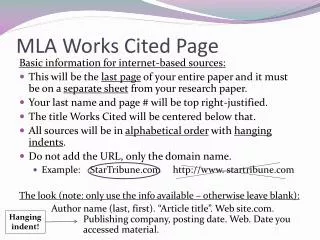
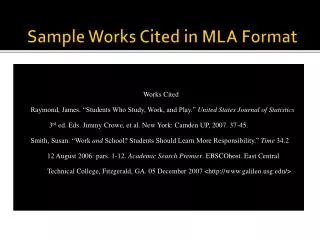
Works Cited • A works cited page is a list of all the sources that were used in order to write your paper. • This page should be titled “Works Cited” and be centered on the page. • The sources are listed in alphabetical order by author’s last name. • If a citation is longer than one line, the remaining lines are indented—hanging indention.
Information Needed to Write a Citation: • Citations vary depending on what type of source you are using. Most (not all) citations will need the following information: • Author • Title • Publisher • Place of Publication • Publication Date • Medium of Publication
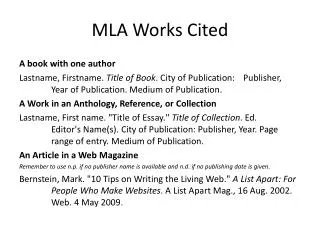
A Book by a Single Author • Author’s last name, first name. Title of the Book. City of publication: Name of Publisher, Year. Medium of publication. • Lore, Pittacus. The Rise of Nine. New York: HarperCollins, 2012. Print.
Practice: • Using the following information, create a citation for a book with a single author. • Author’s Name: Veronica Roth • Title of Book: Insurgent • Publisher: HarperCollins • Year of Publication: 2012 • City of Publication: New York • Medium of Publication: Print
Answer to Practice: • Roth, Veronica. Insurgent. New York: HarperCollins, 2012. Print.