Download
1 / 38
380 likes | 492 Vues
This research explores the nuances between the Quasiparticle Model and Lattice QCD, particularly focusing on the Critical End Point (CEP) of QCD phase transitions. Key findings discuss improved calculations of the equation of state (EoS) and singular contributions relevant to cosmology. Moreover, the paper addresses hydrodynamic models under varying conditions at RHIC and LHC, and how fluctuations in baryon number influence the understanding of phase transitions and freeze-out dynamics. Central to the investigation is the relationship between theoretical models and empirical data.

E N D
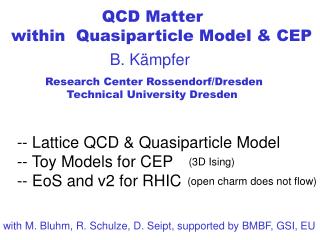
Quasiparticle Perspective on CEP B. Kämpfer Research Center Rossendorf/Dresden Technical University Dresden • Quasiparticle Model vs. Lattice QCD • Including the CEP • - Somewhat Hydro with M. Bluhm, R. Schulze, D. Seipt, supported by BMBF, GSI, EU
nothing NJL Perspective (Fodor et al.) NJL Model (Schaefer-Wambach) PNJL: Weise, Ratti,...
Lattice QCD Results 1. Phase Boundary Improved calculs. 2. EoS = 0 Taylor expansion reweighting, overlapping, complex mu
Quasiparticle Model lattice 1-loop selfenergies effective stat. + thermo.consist.
Bielefeld 2001 E. Shuryak:
Bielefeld-Swansea data Important for Cosmology: T(t) c0 phase transition Important for Cosmology: n(t) c2 c6 c4
c2 QPM susceptibility peak: crit. behavior
Isentropic Expansion chemical freeze-out: T, muB s/n Nf=2 QPM thermodynamics looks fine
T ) kink in (T, (r,h) 2. div. of h r Including the CEP Gebhard, Krey 1. QPM Phenomenological Construction (holds only near CEP)
3. Singular Part of EoS: Parametric Form QCD: 3D Ising Model Guida+Zinn-Justin
0=const (r,h) (R, ) R=const h=const r=const
Toy Model I: smooth reg. EoS 1. pQCD 2. critical curve additional information 170 MeV Allton et al. 2002 3. CEP: Fodor-Katz 333
CEP CEP: Attractor - Repulsor unphysical no focusing effect Wambach et al.
A Funnel Effect due to Phase Transition? Barz, Kämpfer, Csernai, Lukacs PLB 1984 1D Hydro & relaxation time approx. focusing effect squeezing of chem. freeze-out points exp. not observed
Toy Model II: 2-Phase Ansatz Nonaka, Asakawa (2004) critical curve: given by
lattice change of effective carriers of baryon number fluctuations
Need of Modifying lQCD by CEP? K. Paech et al. Hydro with CEP Conjecture: hydro evolution of v2, pT at top-RHIC & LHC does not feel CEP using P. Kolbs code + init.parameters Kolb-Rapp off-equilibrium hadron EoS with U. Heinz/Ohio
2+1 EoS ready? RHIC Init.conds. Karsch Bernard 0.2 Bernard 0.1 Aoki
A Family of EoS‘s QPM + lin.interpol. + + fix * sound waves interpolation is better than extrapolation
Strange Baryons data disfavor phase transition Huovinen 2005: opposite conclusion (inspection of small pT)
D Mesons Meson non-hydro behavior of open charm? or K?
To Do List 1. shape fluctuations K. Werner (core-corona) 2. shape & energy density fluctuations T. Kodama et al.
Summary & Outlook -- Lattice QCD vs. Quasiparticle Model: perfect description of either p(T,0) or p(T,mu) extrapolation to larger mu consistency of chem.freeze-out and isentropes -- Toy models for including CEP: many free parameters, size of critical region = ? lattice QCD + CEP = small effects allowed -- v2 hydro: RHIC: EoS at Tc does not matter too much -- CERN-SPS – CBM-FAIR: very different
hydro lQCD QCD QPM EoS
Relativistic Hydro with U. Heinz/Ohio Init. Conds.: b dependent profiles from wounded nucleon & binary collisions s < 110 fm-3, nB < 0.4 fm-3: RHIC200 P. Kolb et al. Freeze-out: Cooper-Frye, T = 100 MeV Kolb-Rapp off-equilibrium EoS: p(e,nB), T(e,nB), muB(e,nB)
Interpolation is Better than Extrapolation * lQCD lQCD/res.gas/KR V2: weak dependence on EoS
The 10% Problem c2 c0 c0
Progress of lQCD: High-density part fixed High Density EoS x tiny baryon density effects QPM(2.0) : bag model QPM(1.0) Progress of lQCD: Low-density part fixed (=resonance gas: Redlich)