Enhancements in ESMF: Version 2.0 Release and Future Development Plans
The Earth System Modeling Framework (ESMF) has reached a significant milestone with the release of version 2.0 in June 2004. This version introduces a structured hierarchy of data classes, supports multi-use objects for efficient information handling, and integrates tools for multithreading and load balancing. With a focus on community ownership and open development, ESMF is designed for clear visibility into system diagnostics. The project will move towards achieving full adoption of its component layer and coupling by mid-2005, emphasizing parallel regridding and optimized communications. More details can be found on the ESMF website.

Enhancements in ESMF: Version 2.0 Release and Future Development Plans
E N D
Presentation Transcript
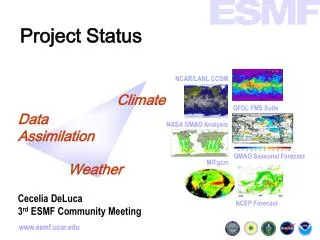
Project Status NCAR/LANL CCSM Climate GFDL FMS Suite Data Assimilation NASA GMAO Analysis GMAO Seasonal Forecast MITgcm Weather Cecelia DeLuca 3rd ESMF Community Meeting NCEP Forecast
ESMF Version 2.0! • Release June 23, 2004 • Usable in real codes, but lots of room for more functionality • Clear, simple hierarchy of data classes • Multi-use objects mean that the same object can carry information about decomposition, communications, IO, coupling • Tools for multithreading, cache blocking, and load balancing are being integrated into the architecture • Objects have consistent naming and behavior across the framework
ESMF Timeline • Public delivery of prototype ESMF v1.0 in May 2003 • Completion of first 3 coupling demonstrations using ESMF in March 2004 • Delivered ESMF v2.0 in June 2004 • All project codes will achieve partial adoption (use of the ESMF component layer and coupling) by November 2004 • All project codes will achieve full adoption (use of the component layer and coupling plus 3 or more utilities) by June 2005
Open Development • Open source • Currently ~800 unit tests, ~15 system tests are bundled with the ESMF distribution, can be run in non-exhaustive or exhaustive modes • Results of nightly tests on many platforms are accessible on a Test and Validation webpage • Test coverage, lines of code, requirements status are available on a Metrics webpage • Exhaustive Reference Manual, including design and implementation notes, is available on a Downloads and Documentation webpage …. Development is designed to allow users clear visibility into the workings and status of the system, to allow users to perform their own diagnostics, and to encourage community ownership
Port Status • SGI • IBM • Compaq • Linux (Intel, PGI, NAG, Absoft, Lahey) • Mac xlf
ESMF Priorities Status • Components, States, Bundles, Fields mature • On-line parallel regridding (bilinear, 1st order conservative) completed • Other parallel methods, e.g. halo, redist, low-level comms implemented • Comm methods overloaded for r4 and r8 • Communications layer with uniform interface to shared / distributed memory, hooks for load balancing Near-term priorities • Concurrent components – currently ESMF only runs in sequential mode • More optimized grids (tripolar, spectral, cubed sphere) and more regridding methods (bicubic, 2nd order conservative) from SCRIP • Comms optimization and load balancing capability • IO (based on WRF IO) • Development schedule on-line, see Development link, SourceForge site tasks
ESMF Multi-Agency Follow-on • 3 ESMF FTEs at NCAR slated to have ongoing funding through core NCAR funds • NASA commitment to follow-on support, level TBD • DoD and NSF proposals outstanding • Working with other agencies to secure additional funds
More Information ESMF website:http://www.esmf.ucar.edu