Exploring the Impact of Forgiveness on Mental and Physical Health Outcomes
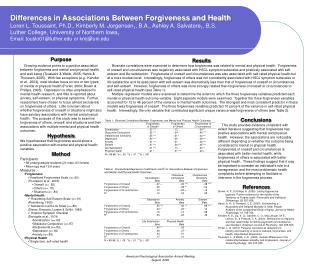
This study investigates the associations between different types of forgiveness—of others, oneself, and circumstances—and various mental and physical health outcomes among 86 undergraduate students. Results indicate that forgiveness of oneself and situations is linked to better mental health, while forgiveness of others relates more strongly to improved physical health. These findings highlight the nuanced effects of forgiveness and suggest that promoting self-forgiveness may enhance mental well-being, whereas forgiving others could be beneficial for physical health.

Exploring the Impact of Forgiveness on Mental and Physical Health Outcomes
E N D
Presentation Transcript
Differences in Associations Between Forgiveness and HealthLoren L. Toussaint, Ph.D., Kimberly M. Jorgensen1, B.A., Ashley A. Salvatore1, B.S.Luther College, University of Northern Iowa1Email: touslo01@luther.edu or kmj@uni.edu • Purpose • Growing evidence points to a positive association between forgiveness and mental and physical health and well-being (Toussaint & Webb, 2005; Harris & Thoresen, 2005). With few exceptions (e.g., Kendler et al., 2003), most studies focus on one or two types of mental or physical health (Porter, 2004; Brown & Phillips, 2005). Depression is often emphasized in mental health research, and little is reported about anxiety, self-esteem, or physical symptoms. Further, researchers have chosen to focus almost exclusively on forgiveness of others. Little is known about whether forgiveness of oneself or situations might also have salutary associations with mental and physical health. The purpose of this study was to examine forgiveness of others, oneself, and situations and their associations with multiple mental and physical health outcomes. • Hypothesis • We hypothesized that forgiveness would show a positive association with mental and physical health variables. • Method • Participants • 86 undergraduate students (23 male, 63 female) • Mean age was 19.6 years • Measures • Forgiveness • Heartland Forgiveness Scale (=.90) (Thompson et al., 2005) • Oneself (= .82) • Others (= .78) • Situations (= .84) • Mental Health • Rosenberg Self-Esteem Scale (=.91) (Rosenberg, 1965) • Satisfaction with Life Scale (=.89) (Diener, Emmons, Larsen & Griffin, 1985) • Hopkins Symptom Checklist (Derogatis et al., 1974) • Somatization (=.90) • Obsessive Compulsive (=.87) • Interpersonal (=.83) • Depression (=.90) • Anxiety (=.89) • Physical Health • Single-item, self-rated health Results Bivariate correlations were examined to determine how forgiveness was related to mental and physical health. Forgiveness of oneself and circumstances was negatively associated with HSCL symptom subscales and positively associated with self-esteem and life-satisfaction. Forgiveness of oneself and circumstances was also associated with self-rated physical health but at a more modest level. Interestingly, forgiveness of others was not consistently associated with HSCL symptom subscales or life satisfaction and its association with self-esteem was dramatically less than that of forgiveness of oneself or circumstances and self-esteem. However, forgiveness of others was more strongly related than forgiveness of oneself or circumstances to self-rated physical health (see Table 1). Multiple regression models were examined to determine the extent to which the three forgiveness variables predicted each mental or physical health outcome variable. Eight separate models were examined. Together the three forgiveness variables accounted for 12 to 46 percent of the variance in mental health outcomes. The strongest and most consistent predictor in these models was forgiveness of oneself. The three forgiveness variables predicted 10 percent of the variance in self-rated physical health. Interestingly, the only variable that contributed significant unique variance was forgiveness of others (see Table 2). Conclusions This study provides evidence consistent with extant literature suggesting that forgiveness has positive associations with mental and physical health. However, the associations are noticeably different depending on whether the outcome being considered is mental or physical health. Forgiveness of oneself and circumstances is associated with better mental health, while forgiveness of others is associated with better physical health. These findings suggest that it may be important to consider an individual’s role in a transgression and the most problematic health complaints before attempting to facilitate or intervene in the forgiveness process. References Brown, R. P., & Phillips, A. (2005). Letting bygones be bygones: Further evidence for the validity of the Tendency to Forgive scale. Personality and Individual Differences, 38, 627-638. Harris, A. H., & Thoresen, C.E. (2005). Volunteering is Associated with Delayed Mortality in Older People: Analysis of the Longitudinal Study of Aging. Journal of Health Psychology, 10, 739-752. Kendler, K. S., Liu, X. Q., Gardner, C. O., McCullough, M. E., Larson, D., & Prescott, C. A. (2003). Dimensions of religiosity and their relationship to lifetime psychiatric and substance use disorders. American Journal of Psychiatry, 160, 496-503. Porter, L. G. (2004). Personal narratives as reflections of identity and meaning: A study of betrayal, forgiveness, and health. Unpublished dissertation. Toussaint, L., & Webb, J. R. (2005). Gender differences in the relationship between empathy and forgiveness. Journal of Social Psychology, 145, 673-685. American Psychological Association Annual Meeting August, 2006