11.2 Changes in Population Size
This text explores the fundamental processes that affect population size, namely immigration, emigration, birth, and death. It explains how these factors collectively influence population change, using the equation N = B - D, where N is population size, B is births, and D is deaths. The concept of biotic potential is introduced, discussing factors like fecundity and lifespan that determine growth rates. The text compares R-selected and K-selected strategies, illustrating how species adapt to their environment and reproductive strategies based on their growth metrics.

11.2 Changes in Population Size
E N D
Presentation Transcript
Measuring Population Change • Four basic processes that change the size of all population • Immigration – movement of individuals into a population • Emigration – movement of individuals out of population • Birth • Death
Population change can be calculated as: N = population size B = Birth D = death I = immigration E = Emigration
For most populations, immigration is equaled by emigration, therefore calculating the Change in Population is as: N = B - D
The growth rate then is calculated as: • Per Capita Growth Rate:
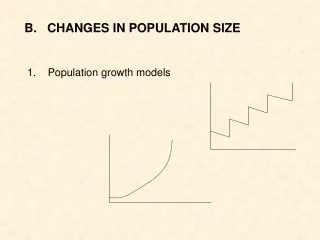
Population Growth Models • Biotic potential (highest possible per capital growth rate) is determined by factors related to fecundity • # of offspring per reproductive cycle • # of offspring that survive to reproduce • Age of sexual maturity • # of offspring produced in life span • Life span of individual
A population growing at its biotic potential experiences exponential growth
A population growing in limited environment would experience a carry capacity
R selected strategy live close to their biotic potential • Short life span • Sexually mature young • Large broods • Little or no parental care
K selected strategy live close to their carry capacity • Relatively long life span • Sexually mature late in life • Less offspring per reproductive cycle • Higher parental care Pg 519 #1-10