Section 3.2 Polynomial Functions and Their Graphs
170 likes | 290 Vues
This guide explores polynomial functions defined as expressions of the form f(x) = anx^n + an-1x^(n-1) + ... + a2x^2 + a1x + a0, where n is a non-negative integer and a0, a1, ..., an are real numbers. Key features of polynomial graphs include their continuity, smooth turns, and the identification of leading coefficients, which determine end behavior. The guide also addresses finding zeros of polynomials and the significance of multiplicities. It serves as a comprehensive overview for understanding the properties and behaviors of polynomial functions.


Section 3.2 Polynomial Functions and Their Graphs
E N D
Presentation Transcript
Section 3.2Polynomial Functions and Their Graphs JMerrill 2005 Revised 2008
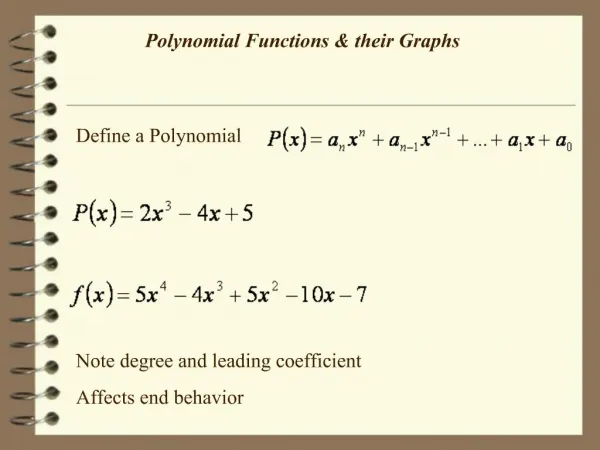
What is a polynomial? • An expression in the form of f(x) = anxn + an-1xn-1 + … + a2x2 + a1x + ao where n is a non-negative integer and a2, a1, and a0 are real numbers. • The function is called a polynomial function of x with degree n. • A polynomial is a monomial or a sum of terms that are monomials • Polynomials can NEVER have a negative exponent or a variable in the denominator! • The term containing the highest power of x is called the leading coefficient, and the power of x contained in the leading terms is called the degree of the polynomial.
Significant features • The graphs of polynomial functions are continuous (no breaks—you draw the entire graph without lifting your pencil). This is opposed to discontinuous functions (remember piecewise functions?). • This data is continuous as opposed to discrete.
Significant features • The graph of a polynomial function has only smooth turns. A function of degree n has at most n – 1 turns. • A 2nd degree polynomial has 1 turn • A 3rd degree polynomial has 2 turns • A 5th degree polynomial has…
Cubic Parent Function Draw the parent functions on the graphs. f(x) = x3
Quartic Parent Function Draw the parent functions on the graphs. f(x) = x4
Graph and Translate Start with the graph of y = x3. Stretch it by a factor of 2 in the y direction. Translate it 3 units to the right.
Graph and Translate Start with the graph of y = x4. Reflect it across the x-axis. Translate it 2 units down.
A parabola has a maximum or a minimum Any other polynomial function has a local max or a local min. (extrema) Max/Min Local max min max Local min
Leading Coefficient Test • As x moves without bound to the left or right, the graph of a polynomial function eventually rises or falls like this: • In an odd degree polynomial: • If the leading coefficient is positive, the graph falls to the left and rises on the right • If the leading coefficient is negative, the graph rises to the left and falls on the right • In an even degree polynomial: • If the leading coefficient is positive, the graph rises on the left and right • If the leading coefficient is negative, the graph falls to the left and right
End Behavior • If the leading coefficient of a polynomial function is positive, the graph rises to the right. y = x3 + … y = x5 + … y = x2
Finding Zeros of a Function • If f is a polynomial function and a is a real number, the following statements are equivalent: • x = a is a zero of the function • x = a is a solution of the polynomial equation f(x)=0 • (x-a) is a factor of f(x) • (a,0) is an x-intercept of f
Example • Find all zeros of f(x)=x3 – x2 – 2x • Set function = 0 0 = x3 – x2 – 2x • Factor 0 = x(x2 – x – 2) • Factor completely 0 = x(x – 2)(x + 1) • Set each factor = 0, solve 0 = x 0 = x – 2; so x = 2 0 = x + 1; so x = -1
You Do • f(x)=-2x4 + 2x2 • Degree of polynomial? • Even • End behavior? • Falls to the left and falls to the right • Zeros? • X = 0, 1, -1
How many roots? How many roots? Multiplicity (repeated zeros) 3 is a double root 3 is a double root 4 roots; x = 1, 3, 3, 4. 3 roots; x = 1, 3, 3.
How many roots? How many roots? Roots of Polynomials Triple root – lies flat then crosses axis Double roots Double roots 5 roots: x = 0, 0, 1, 3, 3. 0 and 3 are double roots 3 roots; x = 2, 2, 2