Download

1 / 10
100 likes | 273 Vues
This section explores the pivotal role of railroads and government initiatives in the westward expansion and settlement of the Great Plains from 1850 to 1900. It delves into major policies like the Homestead Act of 1862, offering land to settlers, and the race between the Union Pacific and Central Pacific railroads, culminating in the meeting of their tracks in Promontory, Utah, in 1869. It highlights challenges settlers faced, including natural disasters and competition for land, and the remarkable agricultural innovations that transformed farming practices on the plains.

E N D
Settling on the Great Plains Notes: Chapter 5 Section 2
I.) Railroads Help Settlers Move West • Federal land policy + transcontinental railroads = rapid settlement of the west! • 1850-1871 federal govt. make huge land grants to RR • Two railroad companies race to lay track: 1. Union Pacific 2. Central Pacific
D. The Central Pacific and Union Pacific tracks meet in Promontory, Utah May 10 1869 (Transcontinental) E. The workers: 1. Civil War vets 2. Irish 3. Chinese 4. African Americans
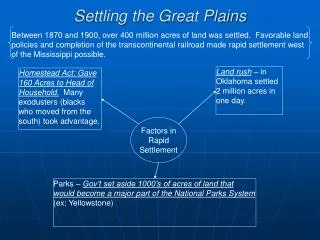
II.) Government Help Settlers Move West • Homestead Act of 1862- act passed by Congress offering 160 acres of free land to any citizen or head of household 1. 1862-1900 over 600,000 families took advantage 2. Exodusters- African-Americans who moved from the south to Kansas • Problems: 1. Railroads & Govt. gobble up land 2. Cattlemen fence off land 3. miners & woodcutters claim natural resources
C. Oklahoma Land Rush of 1889-as part of the Homestead Act, federal govt. offers a major land giveaway in Oklahoma 1. in less than one day settler claim 2 million acres
III.) Closing of the Frontier • In 1872 federal govt. creates Yellowstone National Park • In 1879 federal govt. railroad companies forced to give up landholdings in the West • In 1890 Census Bureau declared the frontier no longer existed
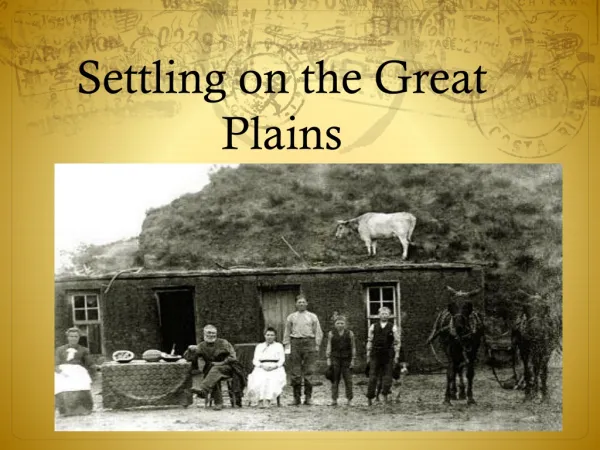
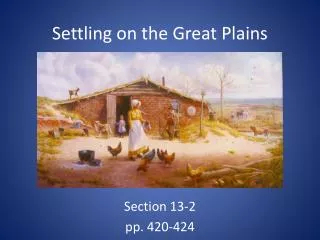
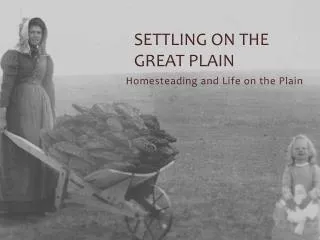
IV.) Life on the Plains • Settlers face droughts, floods, fires, blizzards, raids by outlaws, and Native Americans • Trees are scarce = build home from land itself 1. Soddy- home made by settlers by sod • Women’s Role 1. worked the land, prepared food, cared for home, and raised the children
V.) Agriculture Support • 1837 John Deere invents steel plow • 1847 Cyrus McCormick invents reaping machine • 1869 Spring-tooth Harrow to prep soil • 1841 Grain drill to plant seed • 1874 Joseph Glidden invents barbed wire • 1878 Corn binder and reaper • Outcome: 1. more grain available to wider market 2. 1830 bushel took 183 mins. 1900 bushel took 10 mins.
VI.) Agricultural Farmers A.) Morrill Act of 1862 & 1890- federal govt. gives land to states to establish agricultural colleges B.) Hatch Act of 1887- established experiment stations for development of new agricultural tools 1. Great Plains nickname: “the Breadbasket of the Nation”
Farmers debts rise • Cause & Effect of Prices: 1. price of wheat high = farmers can repay loans price of wheat low = farmers need to raise more crops to meet financial needs • Cost of shipping rises 1. railroads charge high fees to ship