Exploring Self-Interference in Sound Localization: Insights from Neuroscience
This discussion focuses on the self-interference condition required for sound localization, where multiple wave paths converge at the detecting neuron simultaneously. We delve into the communication between specific neurons and how delays relate to spatial location. The concept of mirrored projections and interference integral is examined in the context of neural excitability. We also discuss the significance of spatial wave properties and auto-regulation in neural circuits to maintain accuracy in sound localization, as illustrated by past research including works by Jeffress and Singer.

Exploring Self-Interference in Sound Localization: Insights from Neuroscience
E N D
Presentation Transcript
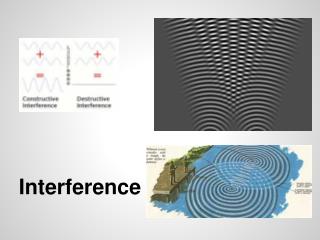
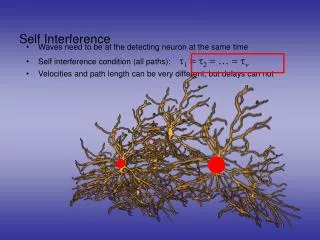
Self Interference • Waves need to be at the detecting neuron at the same time • Self interference condition (all paths): t1 = t2 = … = tn • Velocities and path length can be very different, but delays can not
drawing: d. doebler Sound Localization Model:First Inter-Medial Interference Circuit Model based on: Jeffres L. A.: A place theory of sound localization. J. Comp. Physiol. Psychol. 41 [1948]: 35-39 Tyto alba symmetry line: interference projection (mirrored) right left
1-dim.: Interference Projection • Signals meet at locations with identical delays from source • (all other cases not drawn) • Specific neurons begin to communicate • Address relations between locations given by delays • Time codes location Heinz 1992 It looks like a density modulated signal?
Waves in the Detecting Field? • I² are composed of waves • Didactic suggestions: • homogeneous wave expansion • Linear superimposition (?!) • Wave field. Image pixels symbolize neurons: • 30 channel simulation (Hz 1995) Integration for each pixel (interference integral):
3-dim. Interference Projection • Considered generating and detecting fields • Which properties exist between generating and detecting locations?
3-dim. Interference Projection • Considered generating and detecting fields • Which properties exist between generating and detecting locations? • To find answers we arrange the spiking neurons • we find a mirrored projection "interference integral" (I²)
observation Bi-directional: Singers Synchronization? • Using micro-electrodes, Wolf Singer found 1986 a deep tone in cats cortex • Has he found an interferential wave projection? • To "hold" a projection for some time (learn phase), we need a repetition?
Summary "Self Interference Chapter" Self interference condition maximizes the excitability of a neuron Self interference properties define "mirrored projections" The term "wave" abstracts a two- or higher dimensional movement of spikes through space It is not possible to interpret anything, if we don’t observe all channels of a projection Time defines location: we find a closed relation between geom. wave length and geom. properties of space Self interference is very sensitive against any parameter drift, circuits need auto-control and regulation (-> Hebb's rule in a new light) Non-linear superimposition produces further effects Israel lectures 27/09/05 to 06/10/05 Author:Dr. Gerd Heinz GFaI, 12489 Berlin Albert-Einstein-Str. 16, Floor 5, Room 12B heinz@gfai.dewww.gfai.de/~heinzwww.acoustic-camera.com