Understanding Logarithmic Functions: Key Concepts and Properties
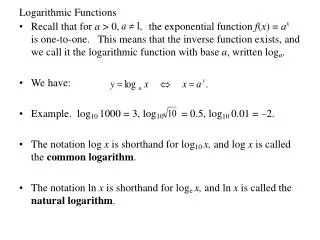
This guide provides essential insights into logarithmic functions, emphasizing their relationship with exponential expressions. Students will explore how the graphs of exp(x) and log(x) serve as inverses, reflected along the line y=x. Key features such as vertical and horizontal asymptotes, domain and range, and intercepts are discussed. Additionally, the properties of logarithms are outlined, including rules for multiplication, division, and exponents. Understanding these concepts is crucial for mastering logarithmic functions in advanced mathematics.

Understanding Logarithmic Functions: Key Concepts and Properties
E N D
Presentation Transcript
What you need to know Students are to develop an understanding of the relationship between exponential and logarithmic expressions The graph of exp(x) and log(x) are inverses of one another Graphically they are reflected along the line y=x How does knowing the inverse give you information about the function?
The graphs of log(x) The graph of log(x) is represented in this graph Through investigation with and without technology students learn key features such as vertical and horizontal asymptotes, domain and range, intercepts, increasing /decreasing behaviour
Properties of exp(x) Properties of log(x) Domain: All real numbers Range: All positive Real numbers Intercepts: dependent on the value of a, f(x) = aexp(x) Domain: Range: Intercepts:
Properties of Logarithms • loga(xy)= logax + logay • loga (x/y )= logax –logay • loga(xr)= r logax • logaa =1 loga1 =0 • loga (1/x) = -logax • log216 = log28 + log22 • log2 (5/3) = log25 - log23 • log2(65) = 5 log26 • log22=1 log31 =0 • log2 (1/3) = -log23
So What is the Differences in College and University Content? • ....?