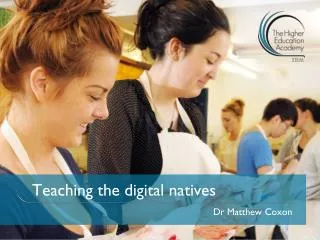
Teaching the digital natives
Join Dr. Matthew Coxon in an engaging workshop aimed at exploring the key issues and emerging trends in Technology Enhanced Learning (TEL). Discover perspectives on how digital natives and digital immigrants interact with technology in education. We will discuss diverse educational tools including blogs, wikis, clickers, gamification, and more, while reflecting on their effectiveness in fostering learning. Engage in discussions about individualized learning and the evolving role of technology in education. Prepare to rethink your approach to teaching learners in a digital world!

Teaching the digital natives
E N D
Presentation Transcript
Teaching the digital natives • Dr Matthew Coxon
Aims of this workshop • To introduce you to issues, debates and emerging trends within technology enhanced learning (TEL); • To reflect on and discuss two different perspectives on some of these issues.
Technology Enhanced Learning • Videos • Audience Response Systems (Clickers)/Online polling • Blogs • Wikis • Online discussions • Computer games (gamification) • Mobile computing • Twitter feeds • Photos • Animations
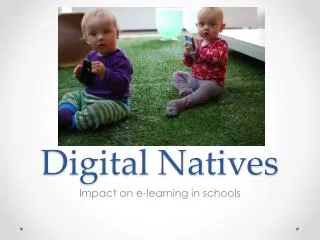
Who are we teaching? • Digital Natives vs Digital Immigrants; • Terms first introduced by Prensky (2001); • Used widely in popular media and now in educational institutions.
Perspective A • Digital natives: • Can multi-task effectively; • Prefer graphics over text; • Seek instant gratification/rewards; • Prefer to collaborate; • Are keen ubiquitous learners; • Who process information in non-linear ways.
Perspective A • Learners have changed, and education needs to; • Individualised/ubiquitous learning, anywhere, anytime; • Problem-based learning to replace formal instruction.
Supported by emerging trends • Blogs; • Wikis; • Online discussions; • MOOCs; • MUDs and MUVEs.
What technology is used? In your groups complete the table with as much as you can think of! On a piece of paper draw the following table
Perspective B MOST FREQUENT LEAST FREQUENT • A hierarchy of actual technology usage (adapted from Thompson, 2013): • Web Resource Use • Rapid Communication Technology • Productivity Tool Use • Gaming • Active Web Reading/Blogging • Multimedia Creation • Collaborative Web Tool Use
Perspective B • Evidence = wide individual differences in usage and expectations; • Students still engage with lectures, instructional activities, books; • A revolution is not inevitable, and may not be necessary.
Some related debates: • (Adapted from Plesch et al., 2013)
Some useful readings Perspective A Barnes, K., Marateo, R., Pixy Ferris, S. (2007). Teaching and learning with the net generation. Innovate: Journal of Online Education, 3(4). Prenksy, M. (2001). Digital Natives, Digital Immigrants. On the Horizon, 9(5). Perspective B Bennett, S., Maton, K., & Kervin, L. (2008). The ‘digital natives’ debate: A critical review of the evidence. British Journal of Educational Technology, 39(5), 775-786. Thompson, P. (2013). The digital natives as learners: Technology use patterns and approaches to learning. Computers & Education, 65, 12-33.
Summary • Technology Enhanced Learning (TEL) is a growing part of educational practice; • Perspectives on ‘who’ we are teaching and how they relate to technology differ widely; • These reflect broader debates within the TEL community, and the fast pace of change.
Discussion time • In pairs choose two ways that technology are used in your departments (e.g. online discussions, twitter, virtual learning environments) • What do you think about how it is used? Do you think it is effective? • Do you think their use reflects Perspective A or Perspective B?