Download
1 / 8
80 likes | 203 Vues
This document synthesizes discussions from the ARCSS Synthesis Retreat held in Lake Tahoe, August 2004, focusing on the idealized pathways and transports for North Atlantic Deep Water (NADW) formation. It addresses the impacts of abrupt changes in thermohaline circulation (THC) on surface temperature and precipitation patterns, along with climate models' responses to THC shutdown and future warming scenarios. The insights gained explore current changes in the North Atlantic and Arctic regions and the interplay of various processes that affect the meridional overturning circulation (MOC) during transient climate changes.

E N D
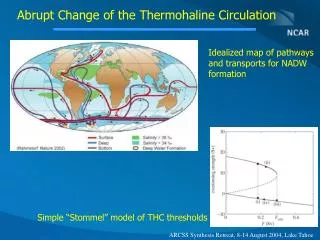
Abrupt Change of the Thermohaline Circulation Idealized map of pathways and transports for NADW formation Simple “Stommel” model of THC thresholds ARCSS Synthesis Retreat, 8-14 August 2004, Lake Tahoe
Response of a climate model to THC shutdown Surface temperature change in third decade Precipitation-minus-evaporation change in third decade ARCSS Synthesis Retreat, 8-14 August 2004, Lake Tahoe
What is happening in the North Atlantic and Arctic at present? ARCSS Synthesis Retreat, 8-14 August 2004, Lake Tahoe
Response of a climate models to future warming ARCSS Synthesis Retreat, 8-14 August 2004, Lake Tahoe
Response of MOC to transient climate change is a result of several competing processes ARCSS Synthesis Retreat, 8-14 August 2004, Lake Tahoe
Abrupt Change of the Thermohaline Circulation Idealized map of pathways and transports for NADW formation Simple “Stommel” model of THC thresholds ARCSS Synthesis Retreat, 8-14 August 2004, Lake Tahoe