Simple Population Model
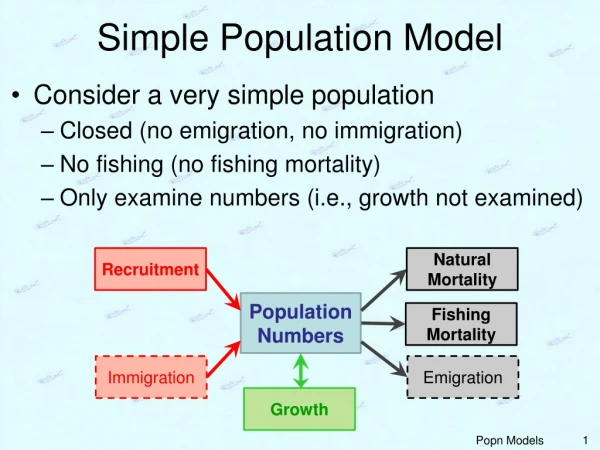
Simple Population Model. Consider a very simple population Closed (no emigration, no immigration) No fishing (no fishing mortality) Only examine numbers (i.e., growth not examined). Recruitment. Natural Mortality. Population Numbers. Fishing Mortality. Immigration. Emigration. Growth.

Simple Population Model
E N D
Presentation Transcript
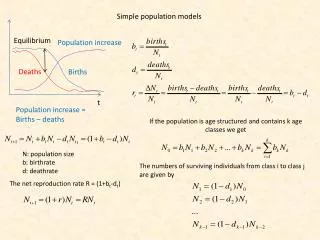
Simple Population Model • Consider a very simple population • Closed (no emigration, no immigration) • No fishing (no fishing mortality) • Only examine numbers (i.e., growth not examined) Recruitment Natural Mortality Population Numbers Fishing Mortality Immigration Emigration Growth Popn Models
Simple Population Model • Define the following: • Nt = Population size (numbers) at time t • N0 = Initial (time=0) population size • b = Per capita recruitment (birth) rate • d = Per capita mortality (death) rate Population Numbers Recruitment Natural Mortality b d Nt Popn Models
Simple Population Model Population Numbers • Consider this … • Draw this … Recruitment Natural Mortality b d Popn Models
Simple Population Model Population Numbers • Now consider this … • And draw this … Recruitment Natural Mortality b d Popn Models
Simple Population Model Population Numbers • Define the following: • bNt • dNt • Construct a model for estimating Nt+1 from Nt • Construct a model for estimating Nt from N0 Recruitment Natural Mortality b d Nt Popn Models
Simple Population Model • What is r? • What are the population dynamics if … • … r = 0 • … r > 0 • … r < 0 • Are these dynamics realistic? Why? Popn Models
More Complex Population Model • If not realistic … • Then what is … Popn Models
More Complex Population Model • Consider this … • Draw this … Popn Models
More Complex Population Model • Consider this … • Sketch this (assume low N0) … Popn Models
More Complex Population Model • Define equation for r • Substitute into exponential growth model and simplify Popn Models
Continuous Models • Discrete models assume annual change • Suppose there are n changes per annum • Period rate of change becomes • Total periods becomes nt • Thus, Nt = N0(1+ )nt • What happens to this model as n ∞ • Substitute x= then let x ∞ Popn Models
Continuous Models • Thus, the continuous analogue is Nt = N0ert • Can also derive from through integration • Thus, r is the instantaneous per capita rate of change • A “rate of change” at a particular moment • “Rate of change” on the natural log scale • Generally not interpretable • Will often convert to annual rates of change Popn Models
Density Independent Popn Growth • Rate of changedoes not depend on population size (i.e., density) Popn Models
Density Dependent Popn Growth • Rate of changedoes depend on population size (i.e., density) Popn Models
Density Dependent Popn Growth • Rate of changedoes depend on population size (i.e., density) … • … but not always in a linear fashion Popn Models