Understanding Significant Figures in Measurement: Rules and Applications
Significant figures are crucial in scientific measurement, impacting accuracy and precision. A measurement becomes more accurate as it approaches the true value, often recorded with more significant figures. This guideline outlines how to identify and use significant figures, including rules for counting non-zero digits, zeroes, and trailing decimals. It also explains how to express values in scientific notation, ensuring clarity in numerical representation. Moreover, we review rounding rules and procedures for addition, subtraction, multiplication, and division in relation to significant figures to maintain precision in calculations.

Understanding Significant Figures in Measurement: Rules and Applications
E N D
Presentation Transcript
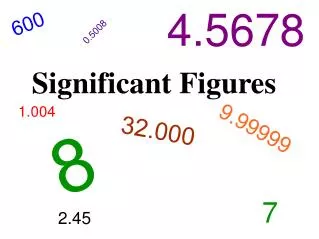
4.5678 600 0.5008 Significant Figures 1.004 8 9.99999 32.000 7 2.45
Measurement always involves some estimating. The more accurate a measurement is, the closer it is to the truevalue. A better instrument allows for better measurements, recorded as a greater number of significant figures (digits).
Recording - include EVERY digit that is absolutely certain...PLUS the ONE digit that is estimated. These are the SIGNIFICANT FIGURES. 3.2 3 estimated certain
1. All non-zero digits are significant. 374 (3 sig figs) 8.1 (2 sig figs) 2. All zeroes between non-zero digits are significant. 50407(5 sig figs) 8.001(4 sig figs) 3. Leading zeroes are NOTsignificant. 0.54(2 sig figs) 0.0098(2 sig figs)
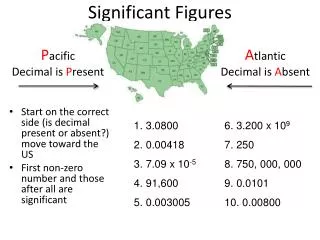
Always LOOK FOR A DECIMAL 4. Trailing zeroes are significant ONLY if there is a decimal point. 2370(3 sig figs) 16000(2 sig figs) 160.0(4 sig figs) 000.1800 (4 sig figs)
To avoid confusion, scientists commonly use SCIENTIFIC NOTATION. ALL digits in scientific notation are SIGNIFICANT 6.02 x 10 23 • Move the decimal so it is behind the first • non-zero digit. • Count the number of places that you moved the • decimal - to the left is +, right is -
238000 2.38 x 10 5 0.0052 5.2 x 10 -3 1.5 x 10 4 15 000 6.35 x 10 -4 0.000635 • 103,000 • 1,236,000 • 42.0 • 0.00000021 • 5. 0.000238 1.03 x 10 5 1.236 x 10 6 4.20 x 10 1 2.1 x 10 -7 2.38 x 10 -4
Rounding Rules 0-4: round down 5 -9: round up 0.00533(2 sig figs) 0.0053 426.3 (3 sig figs) 426 1890(1 sig fig) 2000 0.0296(2 sig figs) 0.030
Rules for Addition and Subtraction Multiplication and Division
You can only give an answer that is as accurate as your least accurate number.
Add or subtract • Count digits to the right of the decimal. • Roundthe answer to match the value with the LEASTnumber of decimal places. 12.0 + 131.59 + 0.2798 = 143.8698 Answer = 143.9 least number of decimal places
Multiply or divide • Answer isrounded to contain the same number of sig figs as the value with the LEAST. 51.3 × 13.75 = 705.375 The answer, with significant figures, is 705.
DO NOT round for each calculation. When performing multiple calculations, use the rule of the final calculation to round the answer. (0.3012 + 0.2)(3.6) = ? (0.5)(3.6) = 1.8 = 2 (0.5012)(3.6) = 1.80432 = 1.8