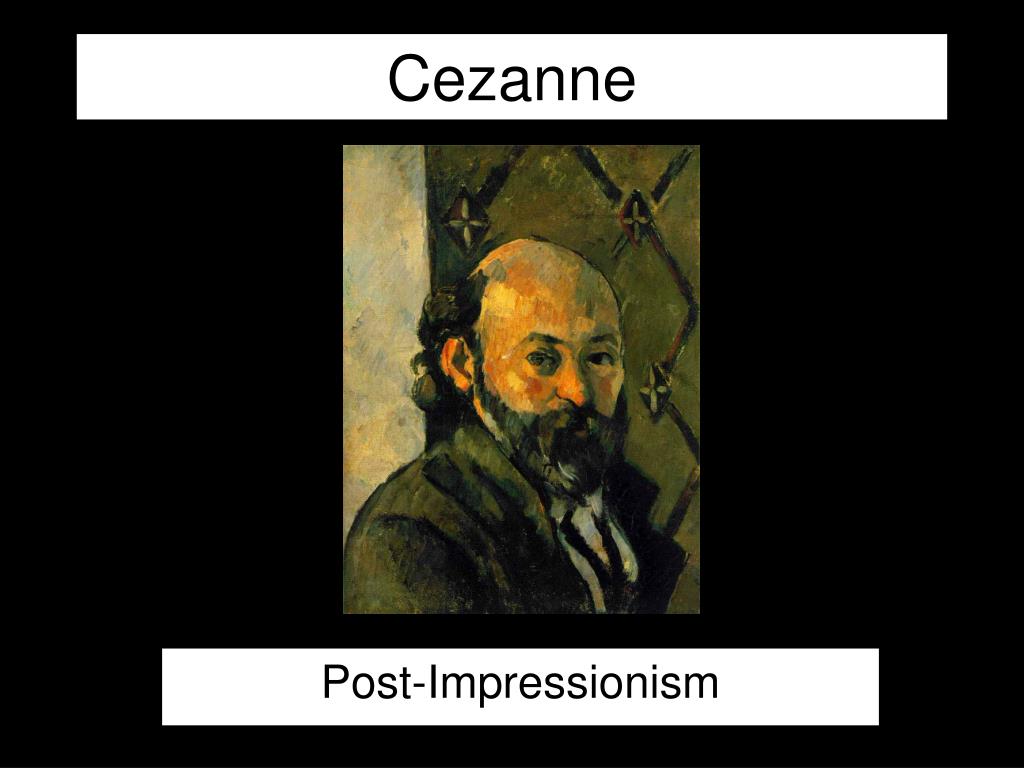
Cezanne Post-Impressionism
Cezanne • Father was stock broker • Cezanne trained as lawyer, while attending drawing academy • Studied in Paris, painted in Impressionists style, but was rejected at 1874 Impressionists exhibition • Went back home (Aix-en -Provence) to continue painting in obscurity • Impressionists used colour to dissolve form, He used patches of colour to build it up.
Cezanne as Impressionist • He was largely untrained so his early work was crude compared to other Impressionists.
Cezanne as Post-Impressionist • Cézanne's grasp of form and solid pictorial structures came to dominate his mature style. • His overriding concern with form and structure set him apart from the Impressionists from the start.
Composition and Solid Form • The subject of the work is less important than a well constructed design and solid forms.
Composition and Solid Form
Composition and Solid Form • The main objects are arranged roughly in a triangle or pyramid.
Composition and Solid Form • He paints still-life, landscape, and the figure as if there is a permanent geometry (cones, cylinders, & spheres) under the surface.
Jug and Fruit 1906
Squarish Patches • Cezanne uses flat squarish patches of colour to serve two purposes: 1) To create a 2D surface for compositional unity, and 2) To suggest separate planes that shape 3D solidity and space.
Still-life with Onions 1895
Painted over a long period of time ( often fruit rotted - replaced with wax fruit) • Forms based on basic geometric forms - cylinder, cubes, cones, & spheres. • Design most imp. - distorts for design - more imp. than imitation of objects.
Works like Still-Life with Onions are often seen from multiple perspectives.
Subject • Form & composition, with colour used to achieve both • Actual subject not as imp. as solid and unified qualities of work as whole
Perspective • Not sitting in same position each time • Influenced Cubism
Composition • Objects, and direction of line are carefully placed for overall asymmetrical balance. • He will even tilt objects to add to flow of composition.
Colour • Warm hues of fruit contrast cool of surroundings. • Warm colours advance and cool colours recede.
Still-life with Plaster Cast 1895
Still-life with Plaster Cast 1895 Subject • Domestic Still-life objects combined with dramatic baroque sculpture (art history)
Still-life with Plaster Cast 1895 • Plaster cupid by Puget is a plaster copy (copy of a copy) & in the background is a painting of a copy of The Flayed Man (copy of copy of copy)
Still-life with Plaster Cast 1895 • Tension between foreground and background • Which is real & which is illusion?
Still-life with Plaster Cast 1895 • There is a tension between two dimensional qualities and three dimensional qualities.
Still-life with Plaster Cast 1895 • Painting contains subtle shifts of perspective due to long period of painting • The artists position changes so perspective changes.
Still-life with Plaster Cast 1895 • The apple placed in background floor is same scale as foreground apples. • Traditional scale & perspective are intentionally ignored in order to balance the composition.
Mont Sainte-Victoire, 1904
Mont Sainte-Victoire • Part of a series painted more than 30 times • The mountain dominates landscape
Mont Sainte-Victoire, 1904 • Form - Distorted, reduced to pyramid shape (geometry)
Mont Sainte-Victoire, 1904 • Perspective- wanted canvas to remain flat, so he didn't use traditional aerial perspective
Mont Sainte-Victoire, 1904 • Space - depth achieve through contrast of warm & cool colour • Compressed space - foreground, middle ground & background painted with same intensity, and similar squarish patches of colour • Canvas maintains flat quality - sky seems as close as foreground
Mont Sainte-Victoire, 1904 • Colour- Felt free to adjust relationships of colour (distort) for design sake. • Modulated - colours and values distributed to produce visual balance