Understanding Static Electricity: How Charges Interact and Are Transferred
Static electricity is the accumulation of electric charge in an object, either positive or negative. It originates from the movement of valence electrons, which can shift between materials when they are rubbed together, creating a charge through friction. For example, rubbing an acetate rod with cloth results in the cloth gaining a negative charge and the rod losing electrons, becoming positively charged. Objects with the same charge repel each other while those with opposite charges attract. Induction is another charging method where a charged object influences an uncharged object nearby.

Understanding Static Electricity: How Charges Interact and Are Transferred
E N D
Presentation Transcript
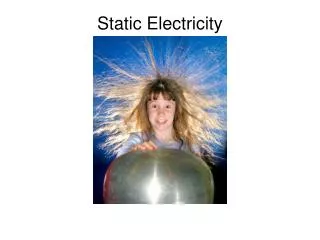
Static Electricity • Static Electricity • abundance of positive or negative charge in an object
- - - - - + - + + - - + - + + + + - + +
- + - + - + - - + - + + - - + - + + - +
StaticElectricity Where does the charge come from? The movement of electrons Loosely held electrons (valence electrons) are able to move between objects and within materials
Static Electricity Charging materials by friction Two materials can become electrically charged when they are rubbed against each other. + - Acetate rod - + Cloth + - + - + - + - Cloth gains negative charge = Negative Acetate loses negative charge = Positive - Home Back Next [S. Ball 2004]
Repel and Attract - - - - - - - - - - - - - - - - - - - - - - - - - - - - - - + + + + + + + + + + Two materials which have the same chargewill repel each other. Two materials which have different chargeswillattracteach other.
- - - - - - - - - - CHARGING BY INDUCTION When a material which is charged comes near something which isn’t charged, it tends to induce a charge. This is because the electrons in the uncharged substance move away from the charged object. - + + - + - + - + + - - + + - - + - - + + - +
Conductors • Conductor • material that allows electrons to move through it easily • e- are loosely held • ex: metals like copper and silver
Insulators • Insulator • material that doesn’t allow electrons to move through it easily • e- are tightly held • ex: plastic, wood, rubber, glass
Static Electricity • Static Discharge • the movement of electrons to relieve a separation in charge
Static Electricity • Grounding • Provides a path for electrons to travel to relieve a difference in charge