Download
1 / 10
110 likes | 251 Vues
A Kindergarten Differentiation Plan. Three needs-based groups (1 hour) Instruction with Teacher Required Follow-up Activity Choice Center. Choice Centers. Listening Comprehension Word Work Writing- for- Sounds. STEP 1. What are your Resources?. Curriculum Resources

E N D
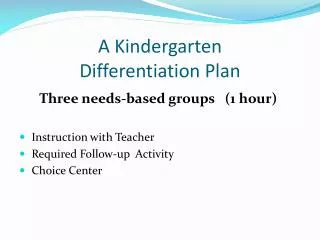
A Kindergarten Differentiation Plan Three needs-based groups (1 hour) • Instruction with Teacher • Required Follow-up Activity • Choice Center
Choice Centers • Listening Comprehension • Word Work • Writing- for- Sounds
STEP 1 What are your Resources? • Curriculum Resources • Core Program • Letter Recognition • Phonemic Awareness • Phonics • Writing • Vocabulary • Listening/Reading Comprehension • Scope & Sequence • Letter & Sound Sequence • Sight Words Sequence (regular & Irregular)
What are your Resources? • Assessments • PPVT-III (Screening) • Phonological Awareness Screener (Diagnostic) • Phonics Screener (Diagnostic) • http://curry.edschool.virginia.edu/reading/projects/garf/ • Sight Word Inventory (Diagnostic) • CBA (Curriculum Based Assessments)
Step 2: Consider Your Children’s Needs Give letter name inventory to all students Give letter sound inventory to students who know at least half of the letter names
Group Students Based on Data 2nd Week: • Use a simple chart to summarize the data • Group children according to: 1. Those with no letter knowledge 2. Those with strong knowledge of letter names & sounds 3. Those with inconsistency of letters and letter sounds • All students who leave K need to have a firm grasp on the alphabetic principle and its application in decoding and spelling unknown words.2
Group Students Based on Data 4th Week: • Administer inventories created to match instruction • Regroup based on new data • Continue this process for each new segment/theme of instruction 12th Week: Begin including a spelling inventory into the assessment/regrouping process
Simple Repetitive Instructional Strategies Content • Changes over time • Changes between groups • Phonemic awareness • Word Recognition
Begin the Year with 2 Strategies • Phonemic Awareness (Chapter 3) • Initial sound sorting • Say - it – and – move - it • Word recognition (Chapter 4) • Letter names and sounds • Sounding and blending • High-frequency words (Elkonin boxes and words, p.66)
What does it look like? • Figure 8.7 page 131 • Organize materials • Review data/core sequence/plan • Deliver instruction • As skills are mastered, increase pace and present more challenging work