Understanding Density: The Relationship Between Mass and Volume in Chemistry
Dive into the concept of density in chemistry, which is defined as mass divided by volume (D = m/V). Explore how objects with lower density float in substances of higher density, illustrated by Archimedes's Principle: the weight of water displaced by an object equals the weight lost by that object. Engage with practical density problems to calculate density from given mass and volume, including examples with aluminum and mercury. Perfect for students seeking to grasp fundamental principles in chemistry related to matter and density.

Understanding Density: The Relationship Between Mass and Volume in Chemistry
E N D
Presentation Transcript
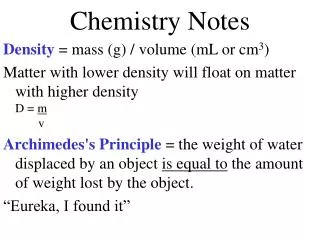
Chemistry Notes Density = mass (g) / volume (mL or cm3) Matter with lower density will float on matter with higher densityD = m v Archimedes's Principle = the weight of water displaced by an object is equal to the amount of weight lost by the object. “Eureka, I found it”
Density math problems D=M/V • mass=20g volume=5mL What is the density? • mass=260g volume=13mL What is the density? • mass=216g volume=12mL What is the density? • mass=931.2g volume=116.4mL What is the density? • mass=121.6g volume=9.5mL What is the density? • A block of aluminum occupies a volume of 15 mL and has a mass of 40.5 g. What is its density? • Mercury is poured into a graduated cylinder that holds 22.5 mL. The mercury used to fill the cylinder weighs 306 g. From this information, calculate the density of mercury.