Introduction to Databases: Understanding DBMS and Data Management
This text introduces Database Management Systems (DBMS), which are designed for efficient, reliable, and safe multi-user access to vast amounts of persistent data. Databases can utilize frameworks for application programming and may work with middleware. Key concepts include data models, schemas, DDL (Data Definition Language), and DML (Data Manipulation Language). Important roles related to DBMS include implementers, designers, developers, and administrators. Whether consciously or unconsciously, users interact with databases daily, showcasing their significance in modern applications.

Introduction to Databases: Understanding DBMS and Data Management
E N D
Presentation Transcript
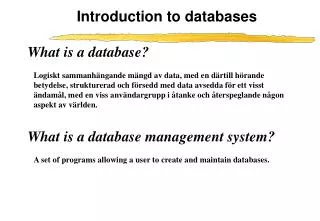
Intro to Databases Database Management System (DBMS) provides…. … efficient, reliable, convenient, and safe multi-user storage of and access to massive amounts of persistent data.
Intro to Databases • Massive • Persistent • Safe • Multi-user • Convenient • Efficient • Reliable
Intro to Databases • Database applications may be programmed via “frameworks” • DBMS may run in conjunction with “middleware” • Data-intensive applications may not use DBMS at all
Intro to Databases Key concepts • Data model • Schema versus data • Data definition language (DDL) • Data manipulation or query language (DML)
Intro to Databases Key people • DBMS implementer • Database designer • Database application developer • Database administrator
Intro to Databases Whether you know it or not, you’re using a database every day