Understanding Ionic Compounds and the Formation of Ions
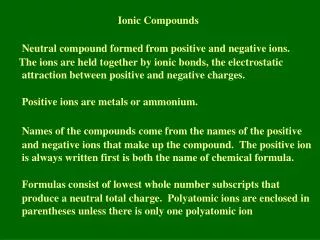
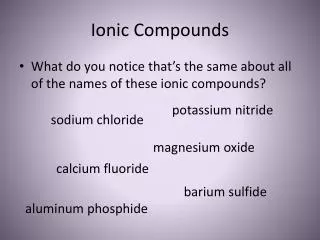
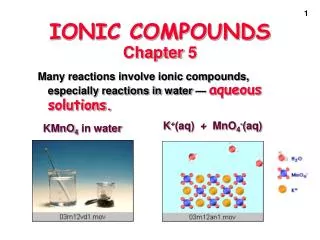
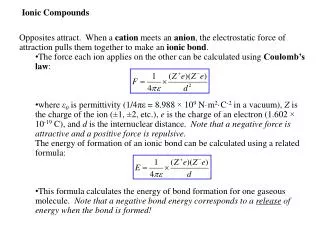
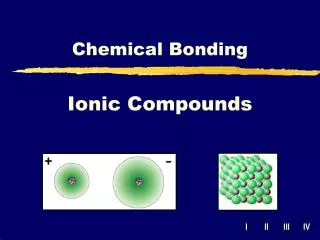
This chapter focuses on chemical bonds, particularly ionic compounds, which are formed via the interaction of cations (positively charged ions) and anions (negatively charged ions). It explains how cations are created when atoms lose electrons, primarily from Groups 1A, 2A, 3A, and occasionally 4A. In contrast, anions are formed when atoms gain electrons, mainly from Groups 5A, 6A, 7A, and sometimes 4A. The chapter also addresses oxidation numbers and the naming of anions, such as chlorides and nitrides, enriching our understanding of ion formation.

Understanding Ionic Compounds and the Formation of Ions
E N D
Presentation Transcript
Chapter 8Ionic Compounds Define chemical bond Describe the formation of postive & negative ions
Important Vocabulary • Chemical Bond- the force that hold 2 atoms together. • This may be formed by an attraction between a (+) nucleus & (-) electrons • Or attraction between a positive ion & a negative ion
Important Vocabulary • Cation- a positively charged ion. • How does this occur? • By losing an electron • Anion- a negatively charged ion. • How does this occur? • By gaining an electron
Formation of Ions • Positive ions are formed when atoms _________ electrons. • Which groups would be most likely to lose (or give up) electrons? Answer: 1A, 2A, 3A, and sometimes 4A • How are negative ions formed? Answer: when atoms gain electrons • Which groups would be most likely to gain electrons? Answers: 5A, 6A, 7A, and sometimes 4A
Oxidation Numbers • How many electrons would atoms of elements in each group lose or give up? • 1A = • 2A = • 3A = • 4A = Answers: 1, 2, 3, and 4, respectively
Oxidation Numbers (continued) • If atoms give up the following number of electrons, what would their charge be: • 1 electron • 2 electrons • 3 electrons • 4 electrons Answers: +1, +2, +3, and +4, respectively
Oxidation Numbers (continued) • How many electrons would atoms of elements in each group gain? • 5A = • 6A = • 7A = • 4A = Answers: 3, 2, 1, and 4, respectively
Oxidation Numbers (continued) • If atoms gain the following number of electrons, what would their charge be: • 1 electron • 2 electrons • 3 electrons • 4 electrons Answers: -1, -2, -3, and -4, respectively
Oxidation Numbers • Why is group 4A listed as gaining 4 electrons OR losing 4 electrons? • The charge on an ion is called its oxidation number. • Knowing this now, go back to your table at the beginning of your notes and fill in the oxidation number column. • What do you think the oxidation number will be for group 4A?
Anion Naming • What is an anion? • A negative Ion • To designate an anion the ending –ide is added to the root name of the element. • Anion of chlorine is called the chloride ion • What is the name for the anion formed from nitrogen? • Nitride
Anion Naming • If an oxygen atoms gains 2 electrons what charge will it have? And what will it’s ion be called? • Oxide ion with a charge of 2-