Understanding Local Linearity and Differentials in Multivariable Calculus
120 likes | 251 Vues
This section explores the concept of local linearity in differentiable functions, illustrating how graph approximations become nearly linear as one zooms in closer. It emphasizes the importance of tangent lines as effective approximations near a point. Additionally, it examines differentials in three-dimensional space, providing insights on how expected changes in function values can be estimated using partial derivatives. The relationship between changes in input variables and expected outcomes is highlighted, noting that greater changes lead to less accurate approximations.


Understanding Local Linearity and Differentials in Multivariable Calculus
E N D
Presentation Transcript
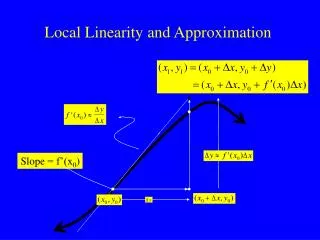
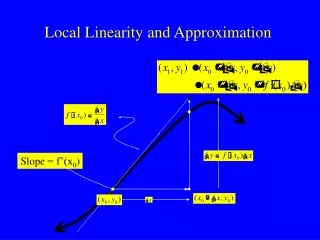
Local Linearity • Let y = f(x) where f is differentiable at x = a • Recall that when we “zoomed in” on a differentiable graph, it became almost linear, no matter how much curve there was in the original graph • Therefore a tangent line at x = a can be a good approximation for a function near a • Let’s take a look at the function and its tangent line at x = 0
Between -.1 and .1 both graphs look almost identical • Now, if we are given an initial height of b and that the line changes by the amount f’(0) per unit change in x, then our line is • Now if we are at x = 3 instead of the intercept, we can adjust our line to get • In general an estimate of f(x) near a is given by
Local Linearity in 3 Space • Recall the general equation of a plane • So we are starting at a height c above the origin and move with slope m in the positive x direction and slope n in the positive y direction • Now on the z-axis • So the tangent plane approximation to a function z = f(x,y) for (x,y) near (a,b) is
Differentials • The differential of f at x = a is defined as • The differential is essentially the distance between two values as we increase (or decrease) x • Let’s use a differential to approximate • Now let’s talk about 3 space
Differentials in 3 space • If z = f(x,y) is a function in 3 space and is differentiable at (a,b), the its differential is defined as • For all x near (a,b) and
Why do we care about differentials? • In two dimensions a differential gives us an expected change in our y-value based on a change in our x-value (and the derivative at that point) • In 3 dimensions we get an expected change in our z-value based on a change in our x and y values (and the partial derivatives at that point) • As these are estimates, the larger the change in the inputs, the less accurate our approximation will be